How to Choose Binoculars: A Detailed Guide to Features and Tips Before Buying
Binoculars are a useful tool for observing nature, birds, wildlife, landscapes, and distant objects. However, choosing the right model is not always straightforward. The market offers compact binoculars for travel, versatile models for hiking and nature observation, and more advanced instruments for users who demand high image quality.
When buying, it is not enough to look only at magnification or price. Objective lens diameter, field of view, prism type, glass quality, optical coatings, minimum focusing distance, ergonomics, and resistance to moisture and dust are also important.
In this guide, we explain how to understand the most important technical specifications, the differences between various designs, and how to choose binoculars to suit your needs.
1. What Do the Numbers on Binoculars Mean?
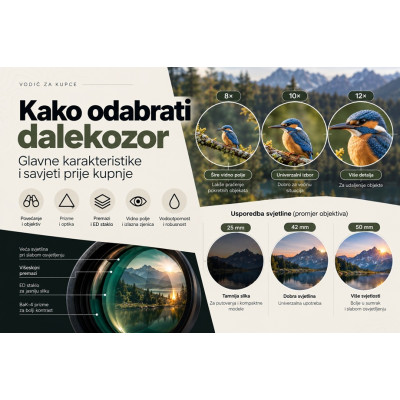
The binocular housing usually carries a designation such as 8×42, 10×42, or 10×50. These two numbers represent the instrument’s basic optical specifications.
The first number indicates magnification, while the second indicates the objective lens diameter in millimetres.
For example, 8×42 binoculars magnify the image eight times and have objective lenses with a diameter of 42 mm. Binoculars marked 10×50 magnify the image ten times and have objective lenses with a diameter of 50 mm.
Magnification
Magnification indicates how many times closer an object appears compared with viewing it with the naked eye. If you observe a bird 80 metres away through binoculars with 8× magnification, its apparent size roughly corresponds to what you would see from a distance of 10 metres without binoculars.
Higher magnification allows you to see details at greater distances, but it also has certain disadvantages:
- hand movements become more noticeable when viewing;
- the field of view is often narrower;
- it is harder to locate a subject quickly and follow it as it moves;
- more stable support may be needed for comfortable viewing.
The highest magnification is therefore not automatically the best choice. For many users, binoculars with 8× magnification are more practical for everyday use than models with 12× or 16× magnification.
Objective Lens Diameter
The objective lenses are the large front lenses of binoculars that collect light. Their diameter affects usability in low-light conditions, as well as the instrument’s dimensions and weight.
The most common sizes are:
- 20–25 mm: compact models for travel, sightseeing, and occasional use;
- 30–32 mm: a good compromise between size and optical performance;
- 40–42 mm: versatile models for nature observation, hiking, and birdwatching;
- 50 mm and larger: models for users who prioritise collecting more light, with increased weight and dimensions.
A larger objective lens does not, by itself, guarantee a better image. Glass quality, optical coatings, prism design, and overall build quality also affect the final result.
2. 8×42 or 10×42 Binoculars: Which Should You Choose?
The 8×42 and 10×42 configurations are among the most popular for nature observation because they offer a good compromise between magnification, objective lens size, and practicality.
Feature | 8×42 Binoculars | 10×42 Binoculars |
Magnification | 8 times | 10 times |
Image stability | Generally better when handheld | Shaking is more noticeable |
Field of view | Often wider | Often narrower |
Following birds in motion | Usually easier | Requires more precise aiming |
Distant subjects | Good view | Greater apparent magnification |
Exit pupil | 5.25 mm | 4.2 mm |
Typical use | Nature, hiking, general use | Open spaces and more distant subjects |
Binoculars with an 8×42 configuration are often a better choice for beginners, birdwatching in forests, and extended nature observation. A wider field of view and a steadier image make it easier to locate a subject and follow its movements.
A 10×42 model may be more suitable when you frequently observe distant subjects in open spaces. However, when choosing, you should consider your ability to hold binoculars steady.
Examples from the Professional Optics Range:
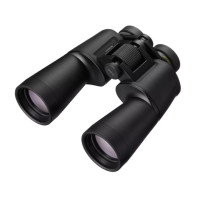
- Konus REGENT-HD 8×42 – a model for users who prefer the versatile 8×42 configuration.
- Konus REGENT-HD 10×42 – an option for those who prioritise higher magnification.
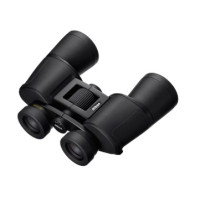
- Nikon ACTION 8×42 – a model intended for birdwatching, nature observation, and sporting events.
When comparing specific products, also check the field of view, minimum focusing distance, weight, and housing protection. Two pairs of binoculars with the same magnification and objective lens diameter do not necessarily provide the same viewing experience.
3. Fixed or Variable Magnification (Zoom)?
In terms of magnification, binoculars are divided into fixed-magnification models and variable-magnification models, also known as zoom binoculars.
With fixed-magnification binoculars, such as 8×42 or 10×42, the magnification remains constant. With variable-magnification models, users can change the magnification within the range specified by the manufacturer.
For example, the designation 10–30×50 means that the binoculars offer magnification from 10 to 30 times and have an objective lens diameter of 50 mm.
Advantages of Variable-Magnification Binoculars
The main advantage of zoom binoculars is flexibility. Lower magnification provides a wider field of view and makes it easier to locate a subject, while higher magnification helps when observing details at greater distances.
These models can be useful for:
- observing distant subjects;
- viewing landscapes at different distances;
- situations where the required magnification cannot be determined in advance.
Disadvantages of Zoom Binoculars
Variable magnification also involves certain compromises. Compared with high-quality fixed-magnification models, some zoom binoculars may have a narrower field of view, lower image brightness at higher magnification, or a more complex optical design.
Sensitivity to hand movements also increases with magnification. At the highest magnification setting, it can therefore sometimes be difficult to obtain a steady image without stable support.
It is also important to check whether the binoculars maintain good image quality throughout the entire magnification range. The ability to change magnification does not automatically mean that a model is optically better or more versatile in all conditions.
Which Should You Choose: Fixed or Variable Magnification?
Feature | Fixed Magnification | Variable Magnification (Zoom) |
Magnification | Constant, for example 8× or 10× | Can be changed within a specified range |
Ease of use | Simple | Requires magnification adjustment |
Field of view | Often wider at comparable magnification | May vary depending on magnification |
Image stability | Generally easier to maintain a steady image at lower magnification | Shaking is more pronounced at higher magnification |
Optical design | Often simpler | More complex due to the magnification adjustment mechanism |
Most suitable use | Nature, birdwatching, hiking, and everyday use | Observing subjects at different distances |
For most users looking for binoculars for hiking, birdwatching, or general use, a high-quality fixed-magnification model, such as 8×42 or 10×42, is often the more practical choice.
Zoom binoculars make sense if the ability to change magnification is particularly important to you. Before buying, check the magnification range, field of view, image quality at the highest magnification, and tripod compatibility.
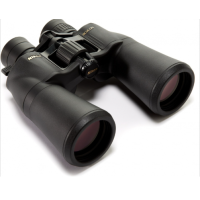
If you are interested in binoculars with variable magnification, pay attention to Nikon ACULON A211 8-18x42 Zoom Versatility Binoculars
4. Exit Pupil and Image Brightness
The exit pupil is an important specification that can be calculated by dividing the objective lens diameter by the magnification.
The formula is simple:
Exit pupil = objective lens diameter ÷ magnification
Examples:
- 8×42: 42 ÷ 8 = 5.25 mm;
- 10×42: 42 ÷ 10 = 4.2 mm;
- 10×50: 50 ÷ 10 = 5 mm;
- 12×50: 50 ÷ 12 ≈ 4.17 mm.
The exit pupil represents the diameter of the beam of light leaving the eyepiece. A larger value can make viewing easier in low-light conditions, particularly when the pupil of the eye is dilated.
However, the exit pupil is not the only factor that determines image brightness. Light transmission through the optical system, glass quality, coatings, and viewing conditions are also important.
For example, high-quality binoculars with 42 mm objective lenses can provide a better image than a less well-made model with 50 mm objective lenses.
What Is Relative Brightness?
Relative brightness is sometimes presented as a calculated value obtained by squaring the exit pupil diameter.
For example:
- for 8×42: 5.25² ≈ 27.6;
- for 10×42: 4.2² ≈ 17.6.
This value can serve as a rough comparison, but it should not be interpreted as a direct measurement of actual image brightness. Optical quality and light transmission also have a significant influence.
Practical tip: if you frequently observe animals early in the morning or towards evening, pay attention to the exit pupil, objective lens diameter, and optical system quality. For daytime viewing on outings, a more compact model may be perfectly sufficient.
5. Field of View: Why Does It Matter?
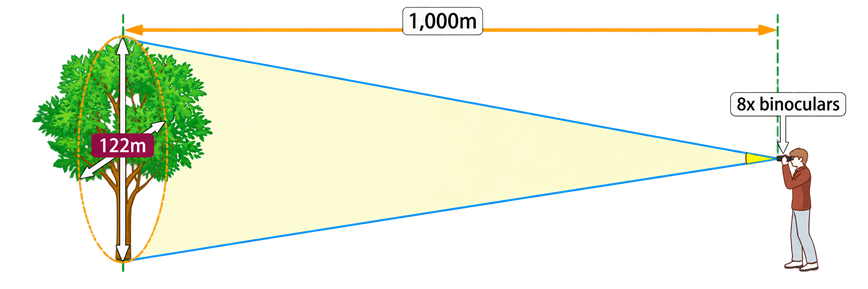
The field of view indicates the width of the area you can see through binoculars. It is most commonly expressed in metres at a distance of 1,000 metres or in angular degrees.
A wider field of view makes it easier to locate subjects and follow their movements. This is particularly useful for:
- observing birds that fly quickly or move among branches;
- following wildlife;
- watching sporting events;
- observing landscapes;
- using binoculars while hiking.
A narrower field of view may be acceptable when the priority is observing distant subjects, but locating the target through the binoculars may take more time.
It is important to understand that the field of view does not depend solely on magnification. The optical design of the specific model also affects it. Always compare the stated technical specifications rather than just the 8× or 10× designation.
Real and Apparent Field of View
The real field of view refers to the angle of the area shown by the binoculars. The apparent field of view describes the apparent angle occupied by the image you see through the eyepiece.
For most buyers, the most practical approach is to compare the field of view width expressed in metres at 1,000 metres. For example, if one model shows a wider area than another, it will be easier to take in a larger area without constantly moving the binoculars.
6. Roof and Porro Prisms: Differences in Design
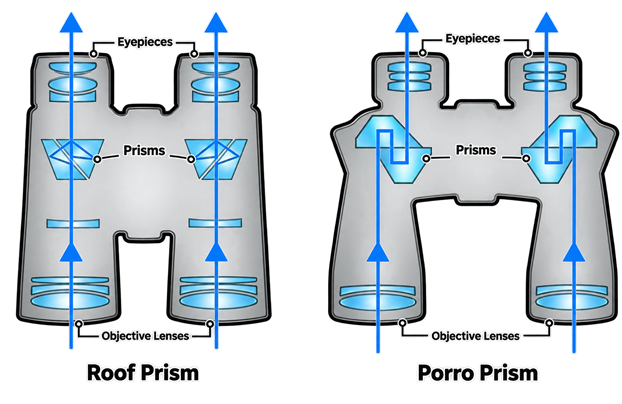
Prisms are optical elements that redirect light inside binoculars and ensure that the image is correctly oriented. Their design affects the instrument’s shape, dimensions, manufacturing complexity, and certain optical characteristics.
The two most common designs are roof and Porro.
Roof Prism Binoculars
Roof prism binoculars usually have a straighter, more compact housing. The objective lenses and eyepieces are approximately aligned, making the instrument more convenient to carry and store.
Advantages of roof prism designs:
- a more compact shape;
- easier carrying when travelling and hiking;
- often more practical ergonomics;
- a wide selection of models with waterproof housings.
With roof prism binoculars, optical coating quality and prism precision are particularly important. Certain designs require special coatings to correct phase shifts, which can increase manufacturing costs.
For this reason, when considering lower-priced models, it is important to check actual image quality rather than assume that all compact binoculars are optically equal.
Porro Prism Binoculars
Porro prism designs are recognisable because the objective lenses are usually spaced farther apart than the eyepieces. These binoculars have a distinctive shape and are often wider than roof prism models.
Advantages may include:
- a good balance between price and optical performance;
- the potential to deliver very good image quality;
- a stronger impression of spatial depth in some models;
- a simpler optical design compared with certain roof prism configurations.
The disadvantages are usually larger dimensions, which can make them harder to carry in a small bag or during long hikes.
Roof or Porro: Which Is the Better Choice?
There is no universal winner. The quality of a particular pair of binoculars depends on the glass, manufacturing precision, optical coatings, and quality control.
If a compact design is important to you, a roof prism model is often more practical. If dimensions are not a deciding factor, it is worth considering Porro prism models, which can offer very good optical quality within their price range.
7. Optical Coatings: What Do Coated and Fully Multi-Coated Mean?
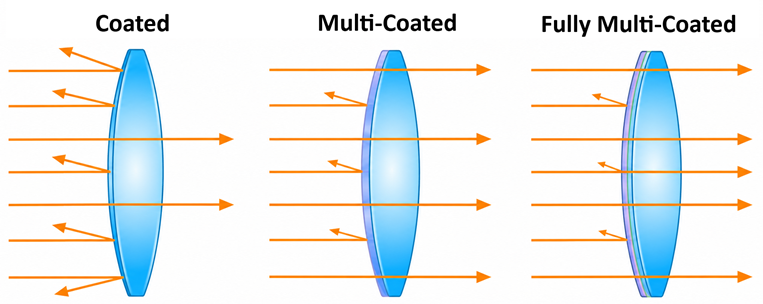
Light is partially reflected at the surfaces of optical elements. If these reflections are not controlled, less light passes through the instrument, and contrast and image quality may be reduced.
Optical coatings reduce reflections and improve light transmission through the system of lenses and prisms.
The following terms may appear in the specifications:
- Coated: a coating has been applied to at least one optical surface;
- Fully Coated: all relevant surfaces have a single-layer coating;
- Multi-Coated: several optical surfaces have multilayer coatings;
- Fully Multi-Coated: all relevant surfaces have multilayer coatings.
Multilayer coatings can help achieve better contrast, more accurate colour reproduction, and higher light transmission.
However, the designation alone does not guarantee an outstanding image. Glass quality, optical system precision, prism treatment, and the quality of protective coatings are also important.
When comparing two models with similar specifications, check which coatings the manufacturer lists and consider their overall optical systems.
8. ED Glass and Chromatic Aberration
ED stands for Extra-low Dispersion. This type of glass is used to reduce chromatic aberration, an optical defect that occurs because different wavelengths of light are not refracted in exactly the same way.
Chromatic aberration can appear as a coloured fringe around high-contrast subjects. For example, when observing a dark branch against a bright sky, a purple or greenish tint may appear along its edge.
ED optics can help reduce this effect and improve the clarity of details.
They are particularly useful for:
- birdwatching and identifying feather details;
- observing animals in open spaces;
- viewing subjects against a bright background;
- users who want better contrast and colour reproduction.
ED glass is not essential for every user. For occasional travel or general nature observation, standard optics may be perfectly sufficient. However, if you frequently observe fine details and want to minimise coloured fringes, an ED model may be worth considering.
9. Minimum Focusing Distance
The minimum focusing distance indicates the shortest distance at which binoculars can show a subject clearly.
This specification is particularly important if you observe:
- butterflies and insects;
- flowers and plants;
- small animals at close range;
- details in nature.
For observing distant landscapes, the minimum focusing distance is usually not a deciding factor. However, for close-range nature observation, it can be one of the key features.
If viewing subjects at short distances is important to you, compare the specifications of several models. Differences can be considerable, even between binoculars with the same magnification.
10. Dioptre Adjustment and Viewing Comfort
Human eyes often differ not only in visual acuity but also in how they focus an image. Dioptre adjustment allows the optical system to be adapted to differences between the left and right eye.
Many binoculars have a dioptre adjustment ring, often located on one of the eyepieces. Before viewing, it is recommended to adjust the dioptre setting and the distance between the eyepieces correctly.
If You Wear Glasses
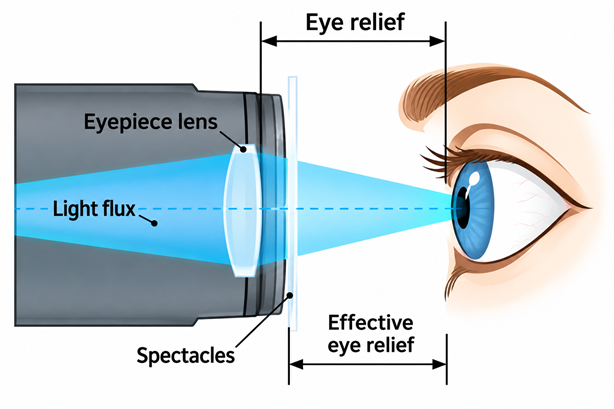
Pay attention to eye relief. This indicates the distance at which your eye should be positioned from the eyepiece to see the entire intended field of view.
If this distance is too short, people who wear glasses may not be able to see the entire field of view without removing their glasses.
Fold-down or adjustable rubber eyecups can make it easier to accommodate different users. However, actual comfort depends on the design of the specific model, so it is worth checking the manufacturer’s specifications.
11. Waterproofing, Fogging, and Housing Durability
Binoculars used outdoors are exposed to rain, moisture, dust, and temperature changes. Housing protection can therefore be an important selection criterion.
Waterproofing
A waterproof housing reduces the risk of water entering the optical system. However, protection levels vary between models. A waterproof designation does not necessarily mean that every pair of binoculars is suitable for immersion in water.
Check exactly what the manufacturer states about the protection of the specific model.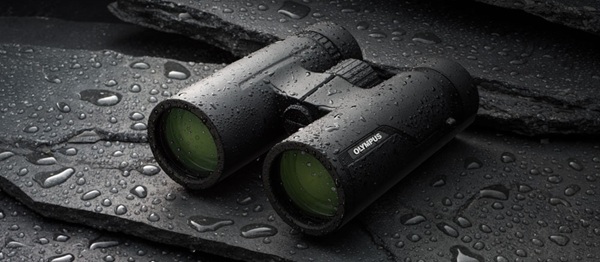
Nitrogen or Argon Filling
Some binoculars are filled with nitrogen or argon. This reduces the amount of moisture inside the housing and the risk of internal fogging during sudden temperature changes.
This can be useful when using binoculars:
- while hiking;
- by the sea or on a boat;
- in rain and high humidity;
- in cold morning or evening conditions.
Rubber Armouring and Impact Protection
Rubber armouring can improve grip and protect the housing against minor impacts. However, rubber armouring alone does not mean that binoculars are waterproof or able to withstand strong impacts.
If you plan intensive outdoor use, check all the information about protection and construction.
12. Which Binoculars Should You Choose for Your Intended Use?
Before buying, consider where you will use your binoculars most often. A model for occasional city sightseeing does not necessarily need the same features as binoculars for extended birdwatching.
Intended Use | Recommended Specifications | Main Priority |
Travel and sightseeing | 8×21 or 8×25 | Low weight and compact dimensions |
Hiking | 8×32 or 8×42 | Comfort, weight, and moisture resistance |
Birdwatching | 8×42 or 10×42 | Field of view, focusing, and image quality |
Wildlife observation | 8×42 or 10×42 | Contrast, brightness, and image stability |
Distant subjects in open spaces | 10×42 or higher magnification | Detail and image stability |
Viewing at dusk | 8×42 or 10×50 | Exit pupil and optical quality |
Sporting events | 8×32 or 8×42 | Wide field of view and tracking movement |
Close-range observation | Depends on the model | Short minimum focusing distance |
These recommendations are general. The final choice depends on optical quality, conditions of use, and personal preferences.
Binoculars for Travel
For travel, low weight, easy storage, and quick use are important. Compact models with 21 to 25 mm objective lenses take up little space and are practical for city walks, sightseeing, and occasional nature observation.
Their main compromise is the smaller objective lens diameter. This can limit performance in low-light conditions compared with larger models.
Binoculars for Hiking
For hiking, you should consider not only the optics but also the instrument’s weight. Binoculars carried for several hours should be comfortable to hold and easy to store.
Models with an 8×32 or 8×42 configuration are often a good choice because they offer a balance between field of view, magnification, and practicality. If you plan to use binoculars in changing weather conditions, pay attention to waterproofing and protection against internal fogging.
Binoculars for Birdwatching
Birdwatching requires quick subject acquisition, tracking movement, and good detail reproduction. Field of view, minimum focusing distance, and optical quality are therefore often just as important as magnification.
An 8×42 model is practical for forests and following birds in motion. A 10×42 model may be better for more distant birds in open areas.
If the quality of detail reproduction is particularly important, you can consider models with ED glass.
Binoculars for Wildlife Observation
Wildlife observation often takes place in changing light conditions. In these situations, it is useful to pay attention to objective lens diameter, exit pupil, and coating quality.
An 8× magnification provides a stable image and makes it easier to follow an animal. A 10× magnification can help when observing animals from greater distances.
For observation in the early morning or evening, a high-quality optical system and an appropriate objective lens diameter may be more important than magnification alone.
13. Weight, Ergonomics, and Accessories
Technical specifications are not the only criteria that determine how practical binoculars will be. Comfort is particularly important if you plan to carry them frequently or use them for extended periods.
When comparing models, check:
- overall weight;
- housing shape and dimensions;
- the material of the gripping surface;
- eyecup adjustment options;
- the position of the focusing control;
- compatibility with a suitable tripod, if supported.
When Is a Tripod Needed?
At higher magnifications, hand movements can make viewing considerably more difficult. A tripod or other stable support can help during prolonged observation, particularly with higher-magnification models.
Not all binoculars are designed for tripod mounting, so check whether the selected model supports this option and whether an additional adapter is required.
What Is Included in the Package?
Depending on the manufacturer and model, the package may include protective lens caps, a carrying case, a carrying strap, and an optical cleaning cloth.
Package contents may vary, so check the description of the specific product.
14. Common Mistakes When Buying Binoculars
Choosing the Highest Magnification
Higher magnification can help when observing distant subjects, but it also makes shaking more noticeable and often reduces the field of view. For general use, 8× magnification is often more practical than 12× or 16×.
Overlooking the Field of View
If you observe birds or other moving subjects, a wide field of view may be more important than additional magnification.
Choosing a Model That Is Too Large and Heavy
Larger objective lenses can be useful in low-light conditions, but they increase dimensions and weight. Consider how long you will carry the binoculars and where you will store them.
Comparing Only by Price
Two pairs of binoculars with the same magnification and objective lens diameter can differ considerably in glass quality, coatings, field of view, and housing protection.
Assuming That All Binoculars Are Waterproof
Rubber armouring is not proof of waterproofing. Protection against water and internal fogging must be confirmed in the specifications.
Overlooking Your Own Needs
The best choice depends on what you observe, the conditions in which you use the instrument, and how much weight you are willing to carry. A model that suits one user may not be the best for another.
15. Frequently Asked Questions About Binoculars
Which Binoculars Are Best for Beginners?
For many beginners, an 8×42 model is a versatile choice. It offers a good compromise between magnification, image stability, field of view, and objective lens size. For travel and occasional use, a compact model may be more practical.
Are 8×42 or 10×42 Binoculars Better?
An 8×42 model usually provides a steadier image and makes it easier to follow moving subjects. A 10×42 model offers higher magnification and may be more suitable for more distant subjects in open spaces.
What Does 10×50 Mean?
It means that the binoculars magnify the image ten times and have objective lenses with a diameter of 50 mm. Larger objective lenses can collect more light, but this type of model is usually larger and heavier than a comparable model with 42 mm objective lenses.
Do I Need Binoculars with ED Glass?
ED glass can reduce chromatic aberration and improve detail and colour reproduction. It is particularly useful for more demanding birdwatching and nature observation, but it is not essential for everyday use.
Is a Roof Prism Design Better Than a Porro Prism Design?
Not necessarily. Roof prism binoculars are usually more compact, while Porro prism models can offer very good optical quality. The quality of the specific model, optical coatings, and how you intend to use the binoculars are more important.
Is a Larger Objective Lens Diameter Always Better?
No. A larger objective lens can collect more light, but it increases weight and dimensions. For daytime viewing and travel, a smaller model may be more practical, while larger objective lenses can be useful in low-light conditions.
What Does Exit Pupil Mean?
The exit pupil represents the diameter of the beam of light leaving the eyepiece. It is calculated by dividing the objective lens diameter by the magnification. A larger exit pupil can make viewing easier in low-light conditions, but it is not the only indicator of image quality.
Can I Use Binoculars If I Wear Glasses?
Yes. It is important to check the eye relief and eyecup adjustment options. Sufficient eye relief can allow you to see the entire field of view through binoculars without removing your glasses.
Which Binoculars Are Best for Viewing at Dusk?
For this use, objective lens diameter, exit pupil, optical coatings, and overall optical system quality are important. An 8×42 or 10×50 model may be a good candidate, but actual performance depends on the specific model.
Conclusion: How to Choose the Right Binoculars?
When choosing binoculars, start with their intended use. For travel and occasional use, low weight and compact dimensions are important. For birdwatching and nature observation, field of view, image stability, and optical quality matter. Higher magnification can be useful for distant subjects, while for viewing at dusk, it is also important to consider objective lens diameter and exit pupil.
For many users, 8×42 binoculars are a good all-round choice. A 10×42 model may be more suitable for more distant subjects, while compact models are practical for travel.
Before buying, compare magnification, objective lens diameter, field of view, optical coatings, prism design, minimum focusing distance, and housing durability.
Explore the range on the Professional Optics – binoculars page and choose a model according to your needs and conditions of use.