
Pulsar Thermion 3 LRF XR60 Thermal Riflescope


Pulsar Thermion 3 LRF XR60 – Thermal Riflescope
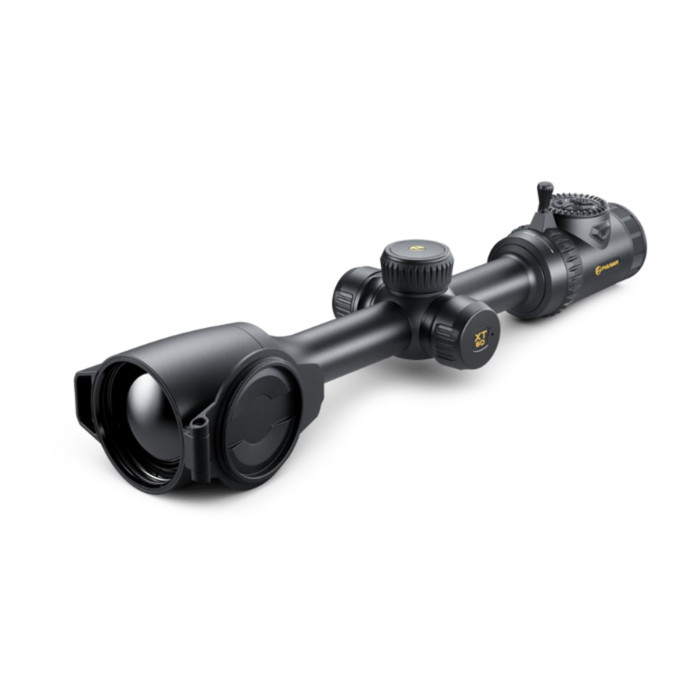
The Pulsar Thermion 3 LRF XR60 combines a 640×480 thermal sensor, a 60 mm F1.0 objective and 4–40× magnification with an integrated 1200 m laser rangefinder. Designed around higher native magnification, it suits open-ground observation and situations where a more magnified starting image is preferable to the widest possible field of view.
An onboard ballistic calculator, scalable electronic reticles and conventional 30 mm ring mounting bring thermal imaging and distance-based aiming information into a familiar riflescope format.
A Closer View from 4×
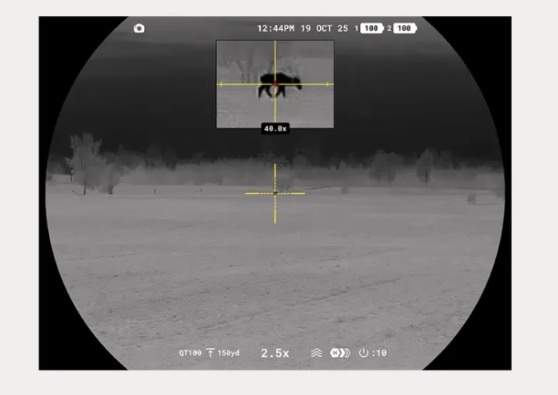
The XR60 starts at 4× magnification, providing a more magnified initial view than the 2× starting image of the Thermion 3 LRF XT60. Its horizontal field of view measures 7.3°, or 12.8 m at 100 m, making it the more distance-oriented configuration within the Thermion 3 range.
This configuration is useful across fields, open clearings and established shooting lanes where the likely target area is already known. The trade-off is a narrower view of the surrounding terrain, which should be considered when choosing a scope for close woodland use or rapidly changing situations.
Magnification extends to 40× through digital zoom. The highest setting enlarges the displayed image rather than adding native sensor detail, so maximum magnification should not be confused with maximum identification capability.
Sensor and Thermal Sensitivity
The XR60 uses an uncooled 640×480 microbolometer with a 12 µm pixel pitch, operating at 50 Hz. Pulsar specifies a sensor NETD below 30 mK and a system NETD below 18 mK.
These sensitivity figures describe different parts of the imaging chain: sensor NETD relates to the detector, while system NETD describes the complete thermal imaging system. The published system sensitivity supports the presentation of subtle temperature differences when the scene has limited thermal contrast.
The F60/1.0 objective pairs a 60 mm focal length with an F1.0 relative aperture. Pulsar declares a detection range of up to 3100 m, but this is not a reliable identification distance or an effective shooting range.
Technical Specifications
Specification | Value |
Model | Pulsar Thermion 3 LRF XR60 |
SKU | 76589 |
Sensor type | Uncooled microbolometer |
Sensor resolution | 640×480 pixels |
Pixel pitch | 12 µm |
Sensor NETD | <30 mK |
System NETD | <18 mK |
Frame rate | 50 Hz |
Objective lens | F60/1.0 |
Magnification | 4–40× |
Horizontal field of view | 7.3°; 12.8 m at 100 m |
Declared detection range | Up to 3100 m |
Dioptre adjustment | −4.5 to +3.5 D |
Eye relief | 65 mm |
Display | Micro-OLED AMOLED, 2560×2560 pixels |
Reticles | 10 electronic reticles, with scalable reticle functionality |
Adjustment range, horizontal/vertical | 2000/2000 mm at 100 m |
Maximum rangefinder distance | 1200 m |
Rangefinder accuracy | ±1 m |
Rangefinder modes | Single measurement, scan and true horizontal distance (THD) |
Laser | 905 nm, Class 1 according to IEC 60825-1:2014 |
Ballistic calculator | Integrated, with Suggested Point of Aim (SPOA) display |
Zeroing profiles | 10 profiles, with up to 10 distances per profile |
Zeroing methods | One-shot, zoom and freeze zeroing |
Colour palettes | 9 |
Sensitivity amplification | Normal, High and Ultra-High |
Smoothing filter | Yes |
Picture-in-Picture | Rectangular and circular modes |
Photo and video resolution | 1440×1080 pixels |
File formats | JPG photographs and MP4 video |
Video recording with sound | Yes |
Internal memory | 128 GB |
Recoil-activated recording | Yes, with three recoil-sensitivity settings |
Shadow Recording | Available |
Wi-Fi | 2.4/5 GHz; IEEE 802.11 b/g/n/ac |
Bluetooth | BLE 4.2; IEEE 802.15.1 |
Supported applications | Stream Vision 2 and Stream Vision Ballistics |
Battery system | Built-in and removable APS5 Li-ion batteries, each 4900 mAh / 3.7 V |
Published operating time | Up to 14 hours in the XR60 overview; 8.5 hours at 22°C in the technical table—see runtime note below |
External power | USB Type-C Power Delivery, 5 V or 9 V |
Protection rating | IP67 |
Operating temperature | −25°C to +50°C |
Recoil compatibility | Rifled firearms using ammunition with muzzle energy up to 6000 J |
Mounting | Standard 30 mm rings |
Housing material | Metal |
Dimensions | 443×96×76 mm |
Weight | 1.25 kg |
Familiar Controls
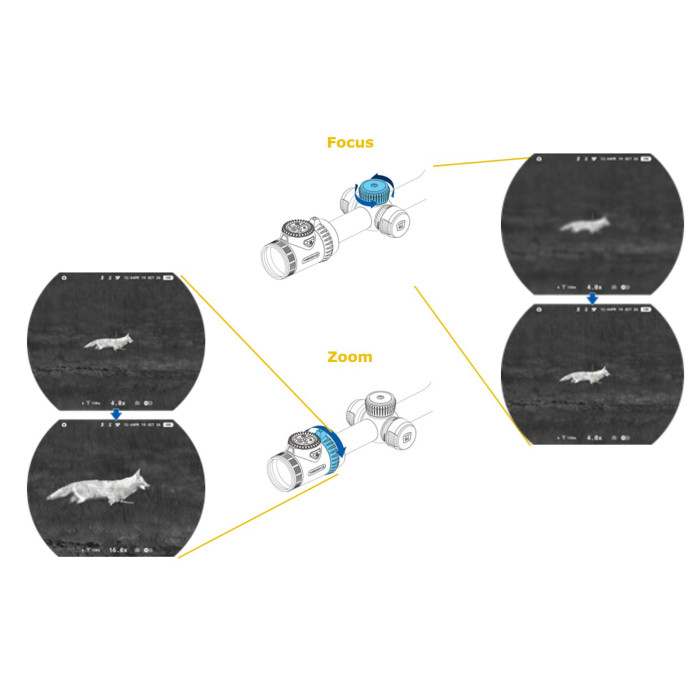
A conventional-style magnification ring with a lever changes zoom without opening an on-screen menu. Its operating direction can be configured clockwise or anticlockwise to match the user’s preferred handling.
Focusing is controlled by a central top turret positioned where the elevation turret would normally sit on a daytime scope. The mechanism is accessible with either hand, while the main operating controls are grouped around the eyepiece.
The interface uses rotational navigation and grouped settings, and a proximity sensor switches the display off when the user moves away from the eyepiece. These features support operation in darkness without repeatedly searching along the scope body for controls.
AMOLED Display and PiP
The 2560×2560 AMOLED microdisplay presents the thermal scene, reticle, measured distance and ballistic information. Its resolution is separate from the 640×480 thermal sensor resolution and the 1440×1080 recording resolution.
Two Picture-in-Picture modes provide different ways to inspect the aiming area. Rectangular PiP presents the target and enlarged view side by side, while circular PiP enlarges the aiming point while retaining the full field of view.
The 65 mm eye relief provides clearance behind the ocular when establishing a comfortable shooting position. Correct scope placement remains important, especially on rifles with substantial recoil.
Image Settings and Palettes
Three sensitivity amplification levels allow the image processing to be adapted to the scene rather than relying on one setting throughout the outing. A switchable smoothing filter reduces image noise, particularly when using Ultra-High amplification.
- Normal: for dry, sunny conditions and scenes containing mixed heat sources.
- High: for most operating conditions.
- Ultra-High: for fog, rain, humidity and low temperatures.
Nine palettes are available: White Hot, Black Hot, Green, Red Hot, Red Monochrome, Rainbow, Ultramarine, Violet and Sepia.
Integrated 1200 m Rangefinder
The laser rangefinder is installed in the housing rather than within the thermal objective. Pulsar states that this arrangement preserves the F1.0 optical path, sensitivity and corner sharpness of the thermal lens.
It measures distances up to 1200 m, with a declared accuracy of ±1 m, and provides three operating modes.
- Single measurement: obtains an individual distance reading.
- Scan: supplies continuously updated measurements.
- THD: displays true horizontal distance when measuring at an angle.
The integrated arrangement allows distance measurement through the riflescope rather than requiring a separate handheld instrument during the aiming process.
Ballistics and Scalable Reticles
The onboard ballistic calculator works with profiles transferred through Stream Vision Ballistics. After the target is ranged, the scope displays corrections for the selected profile and a Suggested Point of Aim—SPOA on the reticle.
Ten electronic reticles provide a choice of aiming patterns. Scalable reticles maintain their angular subtensions as magnification changes, following a principle comparable to first-focal-plane reticles in conventional optics.
Elevation-angle information and lateral cant indicators help the user monitor rifle alignment. Ten zeroing profiles, each holding up to ten distances, organise separate settings; a zeroing profile can also be replaced with a ballistic profile from the application.
A ballistic recommendation should always be treated as a calculation based on the entered data—not as a guarantee of impact. Confirm the rifle, ammunition and zeroing configuration at a suitable range before relying on calculated corrections.
Fine Adjustment and Zeroing
The XR60 provides a horizontal and vertical adjustment range of 2000 mm at 100 m. Click value becomes finer as magnification increases.
Magnification | Click value at 100 m |
4× | 10 mm |
8× | 5 mm |
16× | 2.5 mm |
24× | 1.7 mm |
32× | 1.2 mm |
40× | 1 mm |
Available methods include one-shot zeroing, zoom zeroing for finer adjustment and freeze zeroing, which holds the image steady while the correction is entered.
For initial setup, use a clearly visible thermal target, follow the official zeroing procedure, save the selected profile and verify the result with a confirmation group. Do not assume that a finer electronic click value alone establishes the rifle’s practical accuracy.
Recording and Shot Review
The built-in recorder captures photographs and video with sound, storing files in 128 GB of internal memory. Photographs use JPG format and video uses MP4, both at a published resolution of 1440×1080 pixels.
Recoil-activated recording captures the shot without requiring manual activation at that moment. Three recoil-sensitivity settings allow the trigger response to be matched to different shooting configurations, and Shadow Recording is also available.
Stream Vision 2 supports automatic shot detection within recorded footage, making relevant moments easier to locate during review. This is a recording-review function, not automatic target identification.
Dual Batteries and Runtime
The XR60 uses one built-in and one removable APS5 battery, each rated at 4900 mAh. The removable battery supports replacement in the field, while the built-in battery is also designed to be replaceable.
Runtime clarification: Pulsar’s XR60 overview states up to 14 hours, but the technical table on the supplied official product page lists 8.5 hours at 22°C. These figures conflict, so neither should be presented as an unqualified, confirmed specification until Pulsar clarifies the applicable rating.[pulsarvision]
External power is supported through USB Type-C Power Delivery at 5 V or 9 V. This provides an additional power option for extended sessions using a compatible supply.
Connectivity and Software
Stream Vision 2 supports image streaming, remote control, content management and firmware updates. Stream Vision Ballistics handles the transfer of ballistic profiles to the scope.
Dual-band Wi-Fi operates at 2.4 and 5 GHz, while Bluetooth connectivity uses BLE 4.2. These are connectivity specifications, separate from the thermal sensor’s imaging performance.
Housing and Platform Compatibility
The metal housing is rated IP67, with a declared operating temperature range of −25°C to +50°C. Pulsar specifies compatibility with rifled firearms using ammunition that develops up to 6000 J of muzzle energy; this figure is not recoil energy.
The scope measures 443×96×76 mm and weighs 1.25 kg according to the product specification table. These dimensions should be considered when selecting ring height, checking clearance and balancing the complete rifle setup.
Standard 30 mm rings provide a conventional mounting solution, but the rings and base must still be selected for the particular firearm. Compatibility with 30 mm rings does not mean that mounting hardware is included.
Installation and Care
Before installation, make the firearm safe and ensure it is unloaded. Position the scope for your normal shooting stance, check objective clearance and eye relief, and tighten the mounting hardware according to the relevant manufacturers’ instructions.
Recommended preparation sequence:
- Select a compatible mounting base and appropriately sized 30 mm rings.
- Establish a comfortable scope position before final tightening.
- Adjust the dioptre setting so the displayed information appears clear.
- Focus the thermal image on the intended target area.
- Select a zeroing profile and enter the correct distance.
- Complete zeroing according to the official user manual.
- Save the settings and confirm the result with a verification group.
For cleaning, charging, internal battery replacement and long-term storage, follow the official Pulsar manual. As general care, remove loose dust before wiping optical surfaces, avoid abrasive materials and household solvents, and inspect the mounting hardware regularly.
Professional Optics in Split
Find the Pulsar Thermion 3 LRF XR60 at Professional Optics in Split, Croatia, with competitive pricing and delivery across Europe. Check current availability, the final price and delivery conditions for your destination before ordering.
Before purchasing or using a thermal riflescope, check the regulations governing its acquisition, ownership and use in the destination country.