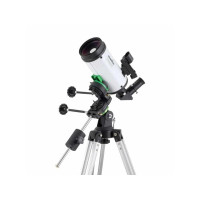
SK-STARQUEST90
Sky-Watcher StarQuest 90MC – Maksutov-Cassegrain Telescope for the Moon and PlanetsSky-Watcher StarQuest 90MC (SK-STARQUEST90) is a compact Maksutov-Cassegrain telescope with a 90 mm aperture and a focal length of 1250 mm, designed for beginners who primarily want to observe the Moon, Jupiter, Saturn and other bright objects in the night sky. Its long focal length is housed within a short optical tube, making this model particularly appealing for lunar and planetary observation when compact optical dimensions are important.The telescope comes with a StarQuest equatorial mount featuring clutches on both axes and slow-motion controls. After basic polar alignment, it enables more precise manual tracking of an object, but requires slightly more learning than a simple alt-azimuth mount.If you are looking for your first compact telescope with an emphasis on the Moon and planets and are prepared to learn basic polar alignment, the Sky-Watcher StarQuest 90MC is one of the models worth considering.Maksutov-Cassegrain 90/1250The Maksutov-Cassegrain design uses a front corrector lens and a system of mirrors to provide a long focal length within a short optical tube. This design suits users whose priorities are the Moon, planets, bright double stars and easier storage of the optical tube.The diameter of the opening, also known as the aperture, is 90 mm. Aperture determines how much light a telescope can collect and how much fine detail it can resolve. In this model, it is sufficient for observing larger and medium-sized features on the Moon, Jupiter’s main atmospheric bands, Saturn’s rings and selected brighter stellar objects.The 1250 mm focal length provides practical magnifications for lunar and planetary observation. The included 25 mm eyepiece provides 50x magnification, while the 10 mm eyepiece provides 125x magnification.The f/13.8 focal ratio suits the observation of small, bright objects at medium and higher magnifications. At the same time, it produces a narrower field of view than short refractors such as an 80/400 model, so the StarQuest 90MC is not primarily designed for surveying large star fields.Technical Specifications Sky-Watcher StarQuest 90MCFeatureValueManufacturerSky-WatcherModelStarQuest 90MCProduct codeSK-STARQUEST90Optical designMaksutov-CassegrainAperture90 mmFocal length1250 mmFocal ratiof/13.8Stated maximum magnification of the optical system180xOptical coatingsAnti-reflection coatings and aluminised mirrorsMountStarQuest equatorial mountMovement systemClutches on both axes and slow-motion controlsFine-adjustment mechanismWorm gear and 122-tooth gear wheelMaximum mount payload3 kgGoTo navigationNoAutomatic trackingNoTripodHeight-adjustable aluminium tripodEyepieces25 mm and 10 mm, 1.25″Magnifications with the included eyepieces50x and 125xFinderscopeIncluded; magnification not specifiedCounterweight shaft and counterweightIncludedTotal weight12 kgEAN8032539194976The stated maximum magnification of the optical system is 180x. However, the included eyepieces provide 50x and 125x magnification, and 125x will often be better suited in practice to observing the Moon, Jupiter and Saturn.An additional compatible eyepiece is required to achieve 180x. The 180x figure should not be interpreted as the optimum magnification for every observing session, as image sharpness will depend on atmospheric stability, the object’s altitude above the horizon, the telescope’s thermal adaptation and precise focusing.Package ContentsSky-Watcher StarQuest 90MC optical tubeStarQuest equatorial mountHeight-adjustable aluminium tripodAccessory tray25 mm eyepiece, 1.25″10 mm eyepiece, 1.25″FinderscopeCounterweight shaftCounterweightThe magnification of the finderscope is not specified in the supplier’s information. A diagonal and Barlow lens are also not listed among the supplied accessories for this version.What Can You See?The MoonThe Moon is the primary observing target for this telescope. The 25 mm eyepiece provides 50x magnification and allows a large portion of the lunar disc to be viewed, while the 10 mm eyepiece provides 125x and offers a better view of craters, mountain ranges, lunar maria and smaller features along the terminator.The terminator is the boundary between the illuminated and dark portions of the Moon. Shadows around craters and mountains in this area accentuate the relief, which is why the Moon often reveals more recognisable features when it is not fully illuminated.Jupiter and SaturnJupiter appears as a clearly recognisable disc accompanied by its four brightest moons: Io, Europa, Ganymede and Callisto. At 125x magnification and under steady atmospheric conditions, the planet’s two main darker atmospheric bands may be visible.Saturn’s rings are clearly separated from the planet’s disc. Titan may be visible as a point of light near the planet, while the ability to detect finer structures in the rings depends on atmospheric stability and precise focusing.Other PlanetsThe phases of Venus can be observed, while Mars generally appears as a small orange-red disc. When Mars is closer to Earth and sufficiently high above the horizon, it may be possible to detect basic variations in its surface brightness.Uranus and Neptune can be located using a precise star chart or astronomy app, but they will remain very small and reveal little detail.Planets will look considerably smaller and less colourful through the eyepiece than they do in processed astronomical photographs.Stars and Deep SkyThe StarQuest 90MC can show bright double stars, open star clusters, the Orion Nebula and the brighter central region of the Andromeda Galaxy. Other brighter deep-sky objects are accessible under darker skies.Galaxies and nebulae will not look the same as they do in astrophotographs. Through the eyepiece, they generally appear as faint, mostly grey structures without intense colours, and their visibility is strongly affected by light pollution.The 90 mm aperture and narrower field of view limit observations of large and faint deep-sky objects. If your main targets are large nebulae, numerous galaxies and globular clusters, a Newtonian or Dobsonian telescope with a larger aperture will be a better choice.Magnification in PracticeCombinationMagnificationRecommended use25 mm eyepiece50xLocating objects, the Moon and brighter star clusters10 mm eyepiece125xLunar craters, Jupiter, Saturn and double starsAdditional compatible eyepieceUp to 180xOccasional lunar and planetary observation under very good conditionsThe 25 mm eyepiece provides 50x magnification and a wider field of view, making it more suitable for initially locating and centring an object. The 10 mm eyepiece provides 125x, which is better suited to studying lunar relief, Jupiter’s atmospheric bands and Saturn’s rings.It is best to begin observing with the 25 mm eyepiece. Once you have located, centred and precisely focused the object, you can switch to the 10 mm eyepiece.StarQuest MountThe StarQuest is an equatorial mount that moves along the right ascension and declination axes. Clutches on both axes allow the telescope to be aimed manually and quickly, while the slow-motion controls are used for precise centring and tracking after the axes have been locked.The fine-adjustment mechanism uses a worm gear and a 122-tooth gear wheel. After approximate polar alignment, an object can be kept within the field of view mainly through corrections along the right ascension axis.Polar alignment means adjusting the mount’s inclination to match the geographical latitude of the observing location and approximately aiming it towards the north celestial pole. The procedure requires slightly more learning than using a simple AZ mount, but it enables more systematic manual tracking.The mount has no GoTo navigation or automatic tracking in its standard configuration. Users locate objects themselves and manually correct their position within the field of view.The maximum mount payload is 3 kg. This is the permitted load on the mount, not the total weight of the complete setup, which is 12 kg.Setup and MaintenanceBefore observing, the tripod must be placed on a firm surface, the counterweight installed and the optical tube correctly balanced. After approximate polar alignment, the finderscope should be aligned with the main telescope, and observation should begin with the 25 mm eyepiece.The enclosed Maksutov-Cassegrain design protects the internal mirrors from dust and generally does not require frequent collimation adjustments. Before more demanding planetary observation, the telescope should be allowed to adapt to the outdoor temperature, particularly when it is moved from a warm room into cold conditions.Never point the telescope towards the Sun without a suitable certified solar filter securely fitted over the entire front aperture of the optical tube.City and Dark SkiesFor observing from a city, the StarQuest 90MC is particularly suitable for the Moon, Venus, Jupiter, Saturn and bright double stars. These objects are bright enough to remain accessible under moderate light pollution.From a darker location, brighter star clusters, the Orion Nebula and the central region of the Andromeda Galaxy become easier to see. Fainter galaxies and nebulae will depend much more heavily on the distance from urban lighting.The Maksutov-Cassegrain design provides a more compact optical tube than a refractor with a similar focal length. However, the complete setup weighs 12 kg, making it more practical for transport by car than for carrying long distances on foot.AstrophotographyThe Sky-Watcher StarQuest 90MC is primarily a telescope for visual observation. The standard manual equatorial mount has no motorised tracking, so the setup is unsuitable for serious long-exposure astrophotography of galaxies and nebulae.With a suitable adapter, it is possible to take basic photographs of the Moon or short videos of bright planets. The long focal length produces a larger planetary image on the sensor, but the final result will depend on the camera, adapter, atmospheric conditions, focusing and mount stability.If serious deep-sky astrophotography is your main goal, you will need a telescope on a precise motorised mount designed for long exposures.Why Choose a 90/1250 Maksutov?A 90/1250 Maksutov-Cassegrain is a good choice when the main priorities are the Moon, planets, double stars and a compact optical tube. The folded optical path provides a focal length of 1250 mm without the long tube that would be required by a conventional refractor with a similar focal length.Compared with a 90/900 refractor, the StarQuest 90MC has the same 90 mm aperture but a longer focal length and a more compact optical tube. A 90/900 refractor adapts to outdoor temperature more quickly, while the Maksutov provides more compact optics and magnifications particularly well suited to the Moon and planets.Compared with a 130/900 Newtonian telescope, the 90/1250 Maksutov collects less light and is not as capable when observing faint deep-sky objects. Its advantages are a more compact optical tube, an enclosed design and a stronger emphasis on lunar and planetary observation.Compared with the Sky-Watcher Skymax 127 AZ-GTi GoTo WiFi, the StarQuest 90MC has a smaller 90 mm aperture and a fully manual equatorial mount. The Skymax 127 AZ-GTi has a 127 mm aperture, providing considerably greater light-gathering power and a better ability to resolve fine details on the Moon and planets. In addition, the motorised AZ-GTi mount provides automatic object location and tracking through a GoTo system controlled by the SynScan app over Wi-Fi.The Skymax 127 AZ-GTi is better suited to users who want a larger aperture, automatic object location and tracking without manually moving the telescope. The StarQuest 90MC is a better choice when a compact optical tube, fully manual operation and a simpler introduction to Maksutov-Cassegrain optics without motors, an app or electrical power are more important.Choose the StarQuest 90MC when your main priorities are a compact optical tube, the Moon and planets, a practical 125x magnification with the included eyepiece, and more precise manual tracking on an equatorial mount.Who Is It For?This telescope is a good choice for:Beginners who want their first Maksutov-Cassegrain telescopeObserving the Moon, Jupiter and SaturnUsers who consider planets more important than large deep-sky regionsBright double starsObserving bright objects from a cityUsers who value a compact optical tubeBeginners prepared to learn basic polar alignmentObserving from a garden, terrace or location accessible by carA gift for a teenager or adult beginnerIt Is Not the Best Choice IfYou want a very wide field of viewYou primarily want to observe large nebulae and faint galaxiesYou do not want to learn polar alignmentYou need GoTo navigation or automatic trackingYou are planning serious deep-sky astrophotographyYou need a very lightweight setup for carrying long distances on footYou primarily want a telescope for daytime nature observationWhy Choose This Model?The Sky-Watcher StarQuest 90MC is designed for beginners who want a compact optical system primarily for observing the Moon and planets. Its 90 mm aperture, 1250 mm focal length, included magnifications of 50x and 125x, and equatorial mount with slow-motion controls provide a solid foundation for regular visual observation.The main advantages of this model are its compact optical tube, 125x magnification with the included eyepiece and more precise manual tracking after polar alignment. Its limitations are its narrower field of view, lower light-gathering power for faint deep-sky objects, manual tracking and a total setup weight of 12 kg.Professional Optics offers an expertly selected range of Maksutov-Cassegrain telescopes, refractors, Newtonian telescopes, mounts and accessories. At our store in Split, you can receive expert assistance in choosing a telescope based on the objects you want to observe and where you plan to use it, with competitive prices and delivery throughout Croatia and Europe...