
Sky-Watcher Newtonian reflector telescope N130/650 Explorer-130PS AZ-EQ Avant
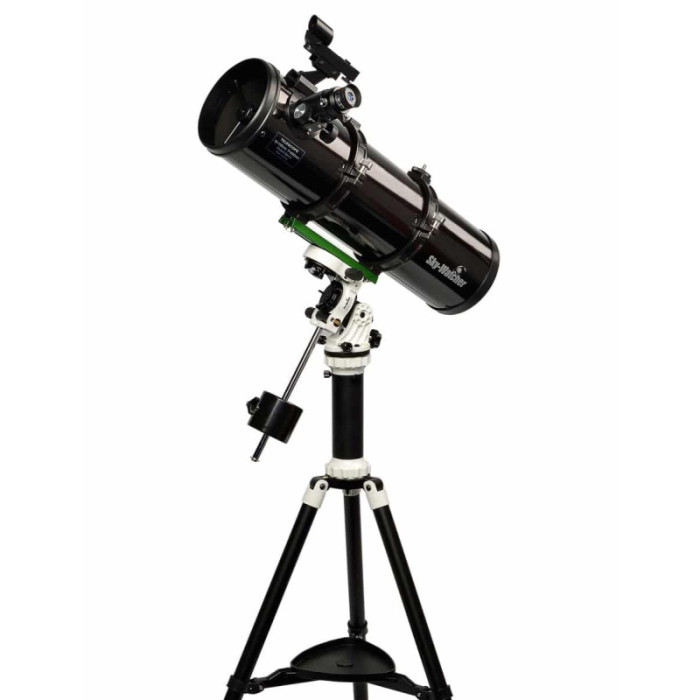
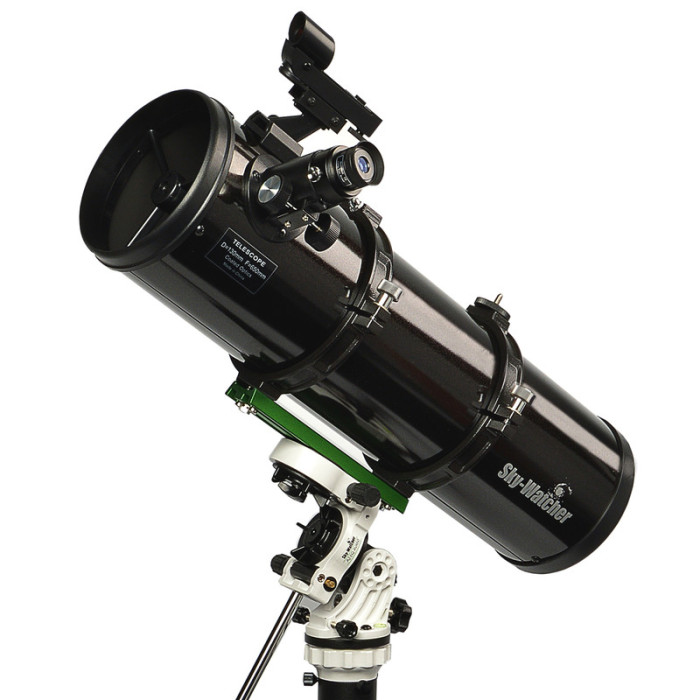


Sky-Watcher Newton 130/650 AZ-EQ Avant – Versatile Telescope for Beginners
Sky-Watcher Newton 130/650 AZ-EQ Avant (SK-AVANT-130N) is a Newtonian reflector telescope with a 130 mm primary mirror and a focal length of 650 mm, designed for beginners who want a versatile first telescope for observing the Moon, planets, star clusters, brighter nebulae and galaxies. The 130 mm aperture provides greater light-gathering capability than refractors with apertures of 70, 80 or 90 mm, while the f/5 optical system provides a wide field of view and a more compact optical tube.
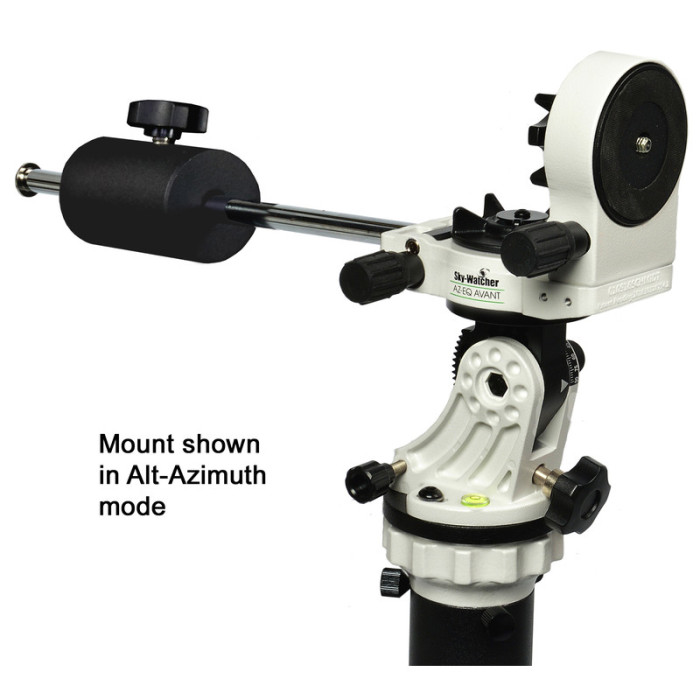
The AZ-EQ Avant mount can be used in both alt-azimuth and equatorial modes. Beginners can start with intuitive AZ aiming and later progress to polar alignment and more precise manual tracking in the EQ configuration.
If you are looking for a versatile first Newtonian telescope that combines a 130 mm aperture, a wide field of view and the option of operating in both AZ and EQ configurations, the Sky-Watcher Newton 130/650 AZ-EQ Avant is one of the models worth considering.
130/650 Newtonian Optics
A Newtonian reflector collects and focuses light using primary and secondary mirrors. Unlike an achromatic refractor, this type of optical system does not produce chromatic aberration—the coloured fringes that may appear around the Moon, planets and bright stars.
The primary mirror diameter, also known as the aperture, is 130 mm. Aperture determines how much light a telescope can collect and how much fine detail it can resolve. A 130 mm aperture expands the selection of accessible targets compared with smaller refractors, allowing users to observe the Moon and planets as well as a greater number of star clusters, brighter nebulae and galaxies.
The 650 mm focal length and f/5 focal ratio provide a wide field of view. This configuration is particularly suitable for observing open clusters, rich star fields in the Milky Way and larger, brighter deep-sky objects, while also offering good possibilities for basic observations of the Moon and planets.
The mirrors have an aluminised reflective surface. Because this is a Newtonian telescope, the alignment of the primary and secondary mirrors—known as collimation—should be checked occasionally, particularly after transporting the telescope.
Technical Specifications
Feature | Value |
Manufacturer | Sky-Watcher |
Model | Newton 130/650 AZ-EQ Avant |
Product code | SK-AVANT-130N |
Optical design | Newtonian reflector |
Primary mirror diameter | 130 mm |
Focal length | 650 mm |
Focal ratio | f/5 |
Stated maximum magnification of the optical system | 260x |
Mirror coating | Aluminised reflective surface |
Mount | AZ-EQ Avant |
Mount operating modes | Alt-azimuth and equatorial |
Fine adjustment | Slow-motion control |
GoTo navigation | No |
Automatic tracking | No |
Tripod | Telescopic aluminium tripod with half-pier |
Accessory tray | Included |
Eyepieces | Super 25 mm and Super 10 mm |
Eyepiece diameter | 31.8 mm / 1.25″ |
Magnifications with the included eyepieces | 26x and 65x |
Finder | Red Dot |
Counterweight shaft and counterweight | Included |
EAN | 8032539193870 |
The stated maximum magnification of the optical system is 260x. However, the included 25 mm eyepiece provides 26x magnification, while the 10 mm eyepiece provides 65x. These are the basic magnifications included in the package, while the telescope’s capabilities can later be expanded with compatible eyepieces or a Barlow lens.
The 260x figure should not be interpreted as the optimum magnification for every observation. The actual useful magnification will depend on atmospheric conditions, the object’s altitude above the horizon, correct collimation, precise focusing and mount stability.
Package Contents
- Sky-Watcher Newton 130/650 optical tube
- AZ-EQ Avant mount
- Telescopic aluminium tripod with half-pier
- Accessory tray
- Super 25 mm eyepiece, 1.25″
- Super 10 mm eyepiece, 1.25″
- Red Dot finder
- Counterweight shaft
- Counterweight
A Barlow lens is not listed among the supplied accessories.
What Can You See?
The Moon
The Super 25 mm eyepiece provides 26x magnification and allows the entire lunar disc to be observed. Larger craters, dark lunar maria, mountain ranges and relief along the terminator—the boundary between the illuminated and dark portions of the surface—can be seen.
The Super 10 mm eyepiece provides 65x magnification and offers a better view of craters and other recognisable lunar features. An additional eyepiece or compatible Barlow lens is required to study smaller details at higher magnification.
Jupiter and Saturn
Jupiter appears as a recognisable disc accompanied by its four brightest moons: Io, Europa, Ganymede and Callisto. When the atmosphere is steady and the planet is sufficiently high above the horizon, its two main darker atmospheric bands may be visible.
Saturn’s rings can be distinguished from the planet’s disc, while Titan may be visible as a point of light nearby. A good-quality additional eyepiece is recommended for a larger planetary image than the included 65x magnification provides.
The phases of Venus can be observed, while Mars generally appears as a small orange-red disc. When Mars is closer to Earth and sufficiently high above the horizon, higher magnification may help when attempting to detect basic variations in its surface brightness.
Planets will look considerably smaller and less colourful through the eyepiece than they do in processed astronomical photographs.
Deep Sky
The 130 mm aperture and f/5 focal ratio make this model an interesting choice for beginners who want to explore brighter deep-sky objects as well as the Moon and planets. Under darker skies, suitable targets include the Pleiades, Hyades, Double Cluster in Perseus, Orion Nebula, Andromeda Galaxy, M13 globular cluster and rich star fields in the Milky Way.
Open clusters can reveal many individual stars, while brighter nebulae may show their basic shape and variations in brightness. Brighter globular clusters will generally appear as compact, glowing structures, with the possibility of partially resolving their outer stars under good conditions.
Galaxies and nebulae will not look the same as they do in astrophotographs. Visually, they usually appear as faint, mostly grey structures, and their visibility depends greatly on dark skies and distance from urban lighting.
For more detailed observation of numerous faint galaxies, nebulae and globular clusters, Newtonian or Dobsonian telescopes with apertures of 150 mm, 200 mm or more offer a greater advantage.
Magnification in Practice
Combination | Magnification | Recommended use |
Super 25 mm eyepiece | 26x | Locating objects, viewing the entire Moon, large star fields and open clusters |
Super 10 mm eyepiece | 65x | Lunar craters, double stars and basic observation of Jupiter and Saturn |
Additional compatible eyepiece or Barlow lens | Higher magnification, depending on the selected accessory | More detailed lunar and planetary observation when atmospheric conditions allow |
The 25 mm eyepiece provides 26x magnification and a wide field of view, making it the best choice for initially locating objects and observing large star fields and open clusters. The 10 mm eyepiece provides 65x and is more suitable for lunar relief, double stars and basic observation of bright planets.
A compatible additional eyepiece or Barlow lens is required for higher magnifications; neither is listed among the standard package contents. The actual useful magnification will depend on atmospheric conditions, the object’s altitude above the horizon, correct collimation, precise focusing and mount stability.
It is best to begin observing with the 25 mm eyepiece. Once you have located, centred and focused the object, you can switch to the 10 mm eyepiece.
AZ-EQ Avant Mount
The main feature of this package is the AZ-EQ Avant mount, which can be used in two operating modes. In alt-azimuth mode, the telescope moves manually left and right and up and down, making it more intuitive for beginners and practical for quick visual observation.
In equatorial mode, the mount is approximately aimed towards the north celestial pole. After polar alignment, an object can be tracked primarily using the slow-motion control on the right ascension axis, making it easier to keep the Moon, a planet or a stellar object within the field of view.
The mount has no GoTo navigation or automatic tracking. Users locate objects themselves with the Red Dot finder and manually correct their position within the field of view.
The choice between AZ and EQ configurations is particularly useful for beginners who want to start with the simpler operating mode and then gradually learn the basics of polar alignment and equatorial tracking.
Setup and Collimation
For the first visual observation, it is practical to use the alt-azimuth configuration. The tripod should be placed on a firm surface, the optical tube securely attached and balanced, and the Red Dot finder aligned with the main telescope.
When using the equatorial configuration, the counterweight must be installed, the telescope balanced and the mount approximately polar aligned. This setup requires more preparation but enables more precise manual tracking.
Newtonian optics occasionally require collimation—the alignment of the primary and secondary mirrors. Collimation does not necessarily need to be adjusted before every observing session, but it should be checked after transporting the telescope or if the image is not sufficiently sharp at higher magnification.
Never point the telescope towards the Sun without a suitable certified solar filter securely fitted over the entire front opening of the optical tube.
City and Dark Skies
From a city, the Sky-Watcher Newton 130/650 is suitable for observing the Moon, Venus, Jupiter, Saturn, bright double stars and open star clusters. A larger aperture does not remove the effects of light pollution, so galaxies and nebulae will appear fainter and show less contrast under urban conditions.
At a darker location, the telescope shows richer star fields, more distinct bright nebulae, globular clusters and more galaxies. If deep-sky objects are an important reason for buying the telescope, observing outside the city will provide a greater benefit than simply increasing magnification.
The short optical tube is easier to store and transport than that of a 130/900 Newtonian telescope. Since the supplier does not state the total weight of the complete setup, this model should not be described as lightweight without additional confirmation.
Astrophotography
The Sky-Watcher Newton 130/650 AZ-EQ Avant is primarily a telescope for visual observation. The option to place the mount in an equatorial position makes manual tracking easier, but the standard package has no motor drive.
With a suitable adapter, it is possible to attempt photographs of the Moon or short videos of bright planets. The manual mount is not suitable for serious long-exposure astrophotography of galaxies and nebulae.
If deep-sky astrophotography is the main goal, a precise motorised equatorial mount with a suitable payload capacity is required. The ability to switch to equatorial mode alone does not make this package a long-exposure imaging system.
Why Choose a 130/650 Newtonian?
A 130/650 Newtonian telescope is a good choice for users who want a versatile first telescope with a larger aperture than refractors with apertures of 70, 80 or 90 mm. The combination of a 130 mm aperture and an f/5 focal ratio supports observations of the Moon and planets but is particularly well suited to large star fields, open clusters and brighter deep-sky objects.
Compared with the Sky-Watcher Explorer 130/900 EQ2, this model has the same 130 mm aperture but a shorter focal length and wider field of view. The Newton 130/650 is more suitable for large star fields, open clusters and users who value a more compact optical tube. The Explorer 130/900, with its longer focal length and included Barlow lens, provides a more practical starting configuration for higher planetary magnifications.
Compared with the Sky-Watcher StarTravel 80/400 AZ3, the Newton 130/650 has a considerably larger aperture and reflector optics without chromatic aberration. It therefore provides greater possibilities for observing star clusters, nebulae, galaxies and planetary details. The StarTravel 80/400 is easier to use and does not require collimation, while the Newton 130/650 requires occasional mirror alignment and slightly more attention during setup.
The AZ-EQ Avant mount is more flexible than a conventional EQ2 because it allows users to choose between alt-azimuth and equatorial operation. Users can begin with simpler manual aiming in the AZ configuration and later learn polar alignment and more precise tracking in the EQ configuration.
Choose the Sky-Watcher Newton 130/650 AZ-EQ Avant when your main priorities are versatile use, a 130 mm aperture, a wide field of view, a compact optical tube and the option of using the mount in either AZ or EQ mode.
Who Is It For?
This telescope is a good choice for:
- A beginner who wants a versatile first Newtonian telescope
- Users who want to combine observations of the Moon, planets and brighter deep-sky objects
- Large star fields, the Milky Way and open clusters
- The Orion Nebula and brighter galaxies under dark skies
- Users who want a 130 mm aperture and a wide field of view
- Users who want to choose between AZ and EQ operating modes
- Beginners who want to learn polar alignment gradually
- Observing from a garden, terrace or darker location
- An adult beginner or a teenager using the telescope with adult assistance
It Is Not the Best Choice If
- You want high planetary magnifications immediately with the included accessories
- You do not want to check the mirror collimation occasionally
- You need GoTo navigation or automatic tracking
- You are planning serious long-exposure astrophotography
- You primarily want a telescope for daytime nature observation
- You want a system that requires no initial assembly or adjustment
Why Choose This Model?
The Sky-Watcher Newton 130/650 AZ-EQ Avant is designed for beginners who want a versatile telescope rather than an instrument focused on only one type of object. The 130 mm aperture provides good possibilities for observing the Moon and planets, together with better access to star clusters, brighter nebulae and galaxies, while the f/5 optical system provides a wide field of view.
The AZ-EQ Avant mount further expands the package’s capabilities: AZ mode makes the first steps easier, while the EQ configuration allows users to learn polar alignment and more precise manual tracking. It is important to consider the need for occasional collimation, manual tracking and an additional eyepiece or Barlow lens if higher planetary magnifications are a priority.
Professional Optics offers an expertly selected range of Newtonian telescopes, refractors, Maksutov-Cassegrain telescopes, mounts and accessories. At our store in Split, you can receive expert assistance in choosing a model according to the objects you want to observe and how you intend to use it, with competitive prices and delivery throughout Croatia and Europe.