CE21062-DS
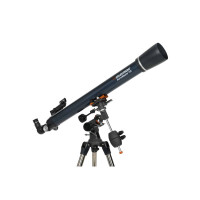
Celestron AstroMaster 70EQ – Telescope for BeginnersCelestron AstroMaster 70EQ is an achromatic refractor telescope with a 70 mm objective lens and a focal length of 900 mm, designed for beginners who want their first telescope primarily for observing the Moon, bright planets and double stars while also learning the basics of using an equatorial mount. The German equatorial mount enables more precise manual tracking after proper polar alignment, while the steel tripod provides a stable base for regular visual observation.This model is particularly suitable for beginners who want to learn not only how to observe the sky but also how to use an equatorial mount. The mount must first be approximately polar aligned, after which a located object can be tracked more easily using the slow-motion control on the right ascension axis.If you are looking for your first refractor telescope primarily for the Moon and bright planets and are prepared to learn the basics of using an equatorial mount, the Celestron AstroMaster 70EQ is one of the models worth considering.70/900 mm OpticsThe objective lens diameter, also known as the aperture, is 70 mm. Aperture determines how much light the telescope can collect. The 70 mm aperture of this model is well suited to initial observations of the Moon, bright planets, double stars and the brightest deep-sky objects.The 900 mm focal length provides practical magnifications for lunar and planetary observation. The included 20 mm eyepiece provides 45x magnification, while the 10 mm eyepiece provides 90x.The f/12.8 focal ratio is suitable for visual observation of the Moon, planets and double stars. Because the AstroMaster 70EQ is an achromatic refractor, slight colour fringing may appear around very bright objects, but chromatic aberration is generally less pronounced than in short achromatic refractors with a much lower focal ratio.Celestron AstroMaster 70EQ Technical SpecificationsFeatureValueManufacturerCelestronModelAstroMaster 70EQOptical designAchromatic refractorObjective lens diameter70 mmFocal length900 mmFocal ratiof/12.8MountGerman equatorial mountSlow-motion controlsYesTracking methodManual, primarily along the right ascension axis after polar alignmentGoTo navigationNoAutomatic trackingNoTripodSteel, pre-assembledEyepieces20 mm and 10 mmEyepiece diameter31.8 mm / 1.25″Magnifications with the included eyepieces45x and 90xDiagonal90° erect-image diagonal, 31.8 mm / 1.25″FinderscopeRed DotTotal weight8.16 kgEAN0050234210621The included 20 mm eyepiece provides 45x magnification, while the 10 mm eyepiece provides 90x. These are the basic magnifications included with the telescope and cover initial object location as well as more detailed observation of the Moon and bright planets.Package ContentsCelestron AstroMaster 70EQ optical tubeGerman equatorial mount with slow-motion controlsPre-assembled steel tripod20 mm eyepiece, 1.25″10 mm eyepiece, 1.25″90° erect-image diagonal, 1.25″Red Dot finderscopeA Barlow lens and motor for automatic tracking are not listed among the standard accessories supplied with this version.What Can You See?The MoonThe Moon is the main observing target for the AstroMaster 70EQ. The 20 mm eyepiece provides 45x magnification and shows the entire lunar disc, while the 10 mm eyepiece provides 90x and offers a better view of larger craters, mountain ranges, dark lunar maria and relief along the terminator.The terminator is the boundary between the illuminated and dark portions of the Moon. Shadows around craters and mountains in this area emphasise the relief, so many features are best seen when the Moon is not fully illuminated.Jupiter and SaturnJupiter appears as a small but clearly recognisable disc accompanied by its four brightest moons: Io, Europa, Ganymede and Callisto. When the atmosphere is steady and the planet is sufficiently high above the horizon, its two main darker atmospheric bands may be visible at 90x magnification.Saturn’s rings can be clearly distinguished from the planet’s disc. Under good conditions, Titan may be visible as a very faint point of light near the planet, but very fine details within the ring structure should not be expected.Other PlanetsThe phases of Venus can be observed. Mars will generally appear as a small orange-red disc, and the possibility of detecting variations in its surface brightness depends on the planet’s distance, its position in the sky and atmospheric conditions.Uranus and Neptune can be located using a star chart or astronomy app, but their small apparent size means that they will reveal very little detail.Planets will look considerably smaller and less colourful through the eyepiece than they do in processed astronomical photographs.Stars and Deep SkyThe AstroMaster 70EQ can show numerous double stars and brighter open star clusters. Under darker skies, it is possible to observe the Pleiades, the Orion Nebula and the brighter central region of the Andromeda Galaxy.Galaxies and nebulae will not look the same through the telescope as they do in astrophotographs. They will generally appear as faint, mostly grey structures without intense colours, and their contrast depends greatly on light pollution.If you are primarily looking for a telescope for numerous galaxies, faint nebulae and globular clusters, the 70 mm aperture will be limiting. For more serious visual observation of deep-sky objects, a Newtonian or Dobsonian telescope with a larger aperture will be a better choice.Magnification in PracticeCombinationMagnificationRecommended use20 mm eyepiece45xLocating objects, viewing the entire Moon, open clusters and daytime observation10 mm eyepiece90xLunar craters, Jupiter, Saturn and double starsAdditional compatible eyepiece or Barlow lensHigher magnification, depending on the selected accessoryMore detailed observation of the Moon and planets when conditions permitThe 20 mm eyepiece provides a wider field of view and is more suitable for initially locating and centring an object. The 10 mm eyepiece provides 90x, a useful magnification for lunar relief, Jupiter’s main atmospheric bands and Saturn’s rings.It is best to begin observing with the 20 mm eyepiece. Once you have located, centred and precisely focused the object, you can switch to the 10 mm eyepiece.Equatorial MountThe AstroMaster 70EQ uses a German equatorial mount. Instead of simply moving left to right and up and down, the mount follows the sky along the right ascension and declination axes.Before observing, the mount must be approximately polar aligned by adjusting its inclination to match the geographical latitude and aiming it towards the north celestial pole. Photographic precision is not required for visual observation, but good initial alignment makes tracking an object easier.After alignment, the Moon, a planet or a star can be tracked primarily by turning the slow-motion control on the right ascension axis. This is particularly useful at 90x magnification, when an object moves out of the field of view more quickly.The mount has no GoTo navigation or automatic tracking. Users locate objects themselves with the Red Dot finderscope and manually correct their position.SetupThe steel tripod is supplied pre-assembled, reducing the time required to prepare the equipment. Before observing, place it on a firm and approximately level surface, attach the optical tube and balance the mount correctly.The Red Dot finderscope should be aligned with the main telescope before its first night-time use. Use the 20 mm eyepiece to locate the first object because its lower magnification provides a wider field of view.Refractor optics do not require regular mirror collimation. When the telescope is not in use, protect the objective lens and eyepieces with their caps and store the equipment in a dry place.Never point the telescope or finderscope towards the Sun without a suitable certified solar filter securely fitted over the entire front objective lens.City and Dark SkiesFor observing from a city, the AstroMaster 70EQ is best suited to the Moon, Venus, Jupiter, Saturn and bright double stars. These objects are less affected by light pollution than faint galaxies and diffuse nebulae.From a darker location outside the city, open star clusters, the Orion Nebula and the brighter regions of the Andromeda Galaxy become easier to see. However, the 70 mm aperture remains limiting for numerous faint deep-sky objects.The complete setup weighs 8.16 kg. It is practical for use in a garden or on a terrace and for transport by car, but its long optical tube and equatorial mount do not make it an ultracompact travel telescope.Daytime ObservationThe included 90° diagonal provides an upright image, allowing the telescope to be used occasionally for observing nature, landscapes and distant objects.However, the equatorial mount and long optical tube are less practical for quick daytime aiming than a simple alt-azimuth mount. The AstroMaster 70EQ should primarily be chosen for astronomy, while daytime observation is an additional option.AstrophotographyThe Celestron AstroMaster 70EQ is primarily designed for visual observation. The manual equatorial mount has no motorised tracking, so the setup is unsuitable for serious long-exposure astrophotography of galaxies and nebulae.With a suitable adapter, basic photographs of the Moon can be taken through the eyepiece using a smartphone. Basic attempts at imaging bright planets are also possible, but the final result will depend on the camera, adapter, atmospheric conditions and mount stability.If deep-sky photography is the main goal, a telescope on a precise motorised equatorial mount will be required.Why Choose a 70/900 Refractor?A 70/900 refractor is a good choice when the main priorities are the Moon, bright planets, double stars and straightforward optical maintenance. Its lens-based objective does not require regular mirror collimation, which is practical for users buying their first telescope.The long 900 mm focal length provides a useful 90x magnification with the included eyepiece and is better suited to lunar and planetary observation than short refractors designed primarily to provide a wide field of view.Compared with simple 70 mm refractors on alt-azimuth mounts, the AstroMaster 70EQ provides a longer focal length and an equatorial mount. It is therefore more suitable for users who want more than quick telescope aiming and wish to learn how to set up a mount correctly and track astronomical objects manually.Other TelescopesModelMain advantageWhen is it a better choice than the AstroMaster 70EQ?When is the AstroMaster the better choice?Konus Konusnova-70 70/800Simple alt-azimuth mount and intuitive aimingIf you want the simplest possible manual aiming without learning to use an equatorial mountIf you want to learn polar alignment and track astronomical objects more precisely by handKonus Konustart-700B 60/700Simpler entry-level telescope for basic observationsIf you want a straightforward introduction to astronomy and basic observations of the Moon and bright objectsIf you want a larger aperture than 60 mm, a longer focal length and an equatorial mountSky-Watcher Mercury 70/700 AZ2Simple mount and easy manual aimingIf ease of use and quick telescope setup are your prioritiesIf you want to learn polar alignment and more precise manual trackingSky-Watcher Evostar 90/900 AZ3Larger 90 mm aperture and simple AZ3 mountIf you want more light-gathering capability and better resolution, particularly for the Moon and planetsIf learning to use an equatorial mount matters more to you than having a larger apertureSky-Watcher Newton 130/650 AZ-EQ AvantLarger aperture, wide field of view and AZ/EQ operating modesIf you want more capability for deep-sky objects, wider star fields and a larger apertureIf you want simpler refractor optics without collimation and primarily intend to observe the Moon and bright planetsChoose the Celestron AstroMaster 70EQ when your main priorities are the Moon and bright planets, refractor optics that do not require collimation, and learning to use a manual equatorial mount.Who Is It For?This telescope is a good choice for:Beginners buying their first refractor telescopeUsers who primarily want to observe the Moon and bright planetsBeginners prepared to learn basic polar alignmentUsers who want to track objects manually with an equatorial mountUsers who want 90x magnification with the included eyepieceObserving bright double stars and open star clustersObserving bright objects from a cityFamily observation from a garden or terraceTeenagers using the telescope with adult assistanceOccasional daytime observation of distant objectsIt Is Not the Best Choice IfYou want the simplest possible aiming without polar alignmentYou need GoTo navigation or automatic trackingYou primarily want to observe faint galaxies and nebulaeYou want a wider field of view for large star clusters and extended deep-sky objectsYou are planning serious long-exposure astrophotographyYou need a very compact travel telescopeYou do not want to learn how to use an equatorial mountYou expect highly detailed planetary views at extreme magnificationsWhy Choose This Model?The Celestron AstroMaster 70EQ is designed for beginners who want their first telescope primarily for observing the Moon and bright planets and are prepared to learn the basics of equatorial tracking rather than simply using the easiest possible manual aiming system. Its 70 mm objective lens, 900 mm focal length, included magnifications of 45x and 90x, and steel tripod provide a practical foundation for regular visual observation.The main advantages of this model are refractor optics that do not require collimation, useful 90x magnification with the included eyepiece and an equatorial mount for more precise manual tracking. It is important to consider the need for initial polar alignment, manual object location, a narrower field of view than short refractors and the limitations of a 70 mm aperture for faint deep-sky objects.Professional Optics offers an expertly selected range of Celestron and Konus telescopes, eyepieces, mounts and accessories. At our store in Split, you can receive expert assistance in choosing a telescope based on the objects you want to observe and how you plan to use it, with competitive prices and delivery throughout Croatia and Europe...