
Sky-Watcher Maksutov-Cassegrain telescope SkyMax-127 AZ-GTi GoTo WiFi
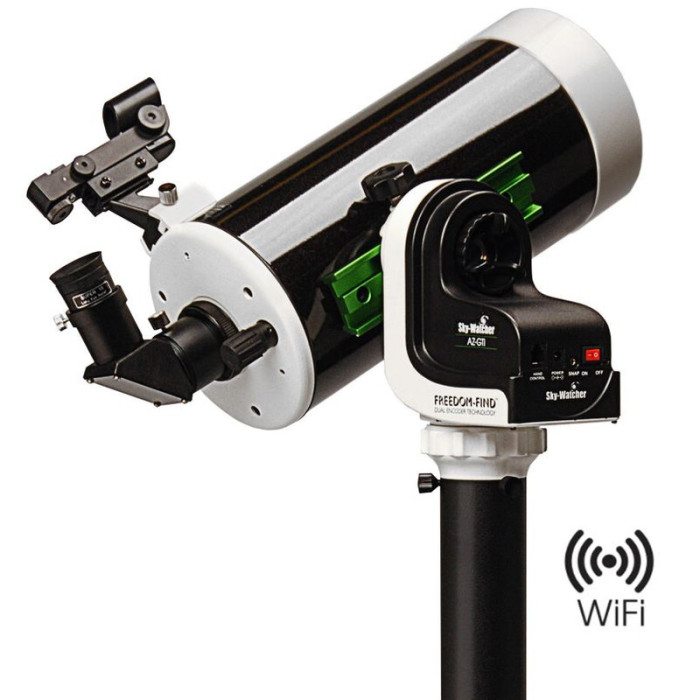
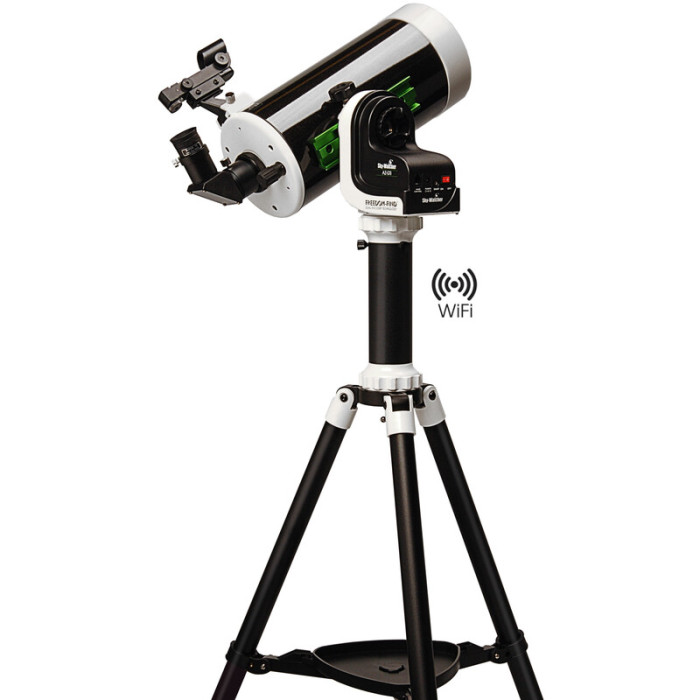


Sky-Watcher SkyMax-127 AZ-GTi GoTo WiFi – Maksutov-Cassegrain Telescope for the Moon and Planets
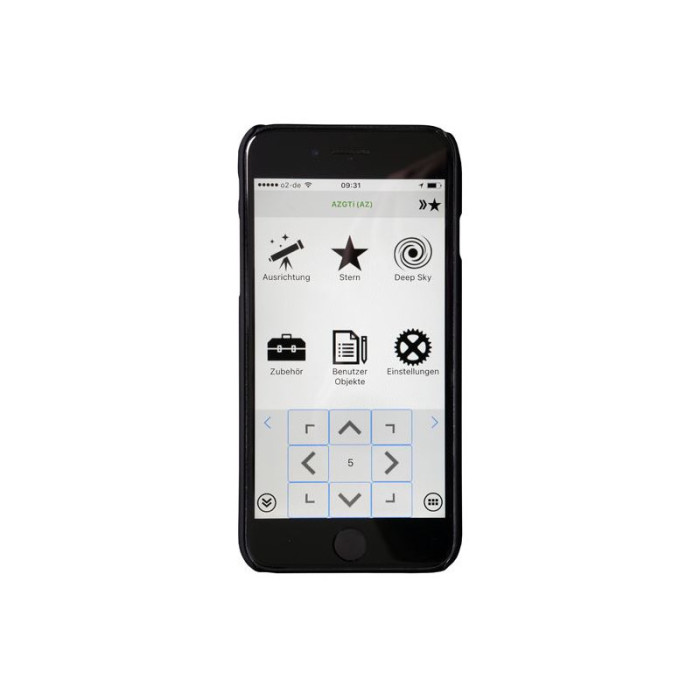
Sky-Watcher SkyMax-127 AZ-GTi GoTo WiFi is a compact Maksutov-Cassegrain telescope with a 127 mm aperture and a focal length of 1500 mm, designed for beginners and more experienced users who primarily want to observe the Moon, Jupiter, Saturn, Mars and bright double stars. The motorised AZ-GTi alt-azimuth mount automatically locates and tracks celestial objects and is controlled through the SynScan app on a smartphone or tablet.
The combination of a 127 mm aperture and long focal length is particularly well suited to observing the Moon and planets at medium and higher magnifications. At the same time, the optical tube remains considerably more compact than a conventional refractor with a similar focal length.
If you are looking for a compact GoTo telescope for the Moon and planets that can automatically locate and track a selected object, the Sky-Watcher SkyMax-127 AZ-GTi GoTo WiFi is one of the models worth considering.
Optical System – Maksutov-Cassegrain 127/1500
The SkyMax-127 uses a Maksutov-Cassegrain optical system that combines a front corrector lens with mirrors inside the optical tube. The folded optical path provides a long focal length of 1500 mm within a relatively short and compact optical tube.
127 mm Aperture
The objective diameter, also known as the aperture, is 127 mm. A larger aperture collects more light and provides a greater ability to resolve fine detail compared with smaller telescopes.
Compared with a 90 mm aperture, the light-collecting surface area is approximately twice as large. This is particularly noticeable when observing the Moon, planets and brighter deep-sky objects.
1500 mm Focal Length
The long focal length is particularly suitable for observing the Moon and planets at medium and higher magnifications.
With the included eyepieces:
- 25 mm → 60x
- 10 mm → 150x
The f/11.8 optical system provides a relatively narrow field of view compared with short refractors and Newtonian telescopes. The SkyMax-127 is therefore not primarily designed for observing very large star fields or exceptionally extensive diffuse nebulae.
Focusing is performed by moving the primary mirror using the side-mounted focusing mechanism.
Technical Specifications Sky-Watcher SkyMax-127 AZ-GTi GoTo WiFi
Specification | Value |
Manufacturer | Sky-Watcher |
Model | SkyMax-127 AZ-GTi GoTo WiFi |
Optical system | Maksutov-Cassegrain |
Aperture | 127 mm |
Focal length | 1500 mm |
Focal ratio | f/11.8 |
Resolving power | 0.91″ |
Limiting magnitude | 12.3 |
Stated maximum useful magnification | 254x |
Focusing | By moving the primary mirror |
Eyepiece diameter | 1.25″ |
Camera connection | T2 |
Thread on optical tube | 1/4″ |
Optical tube weight | 3.5 kg |
Mount | Motorised AZ-GTi alt-azimuth mount |
Mount payload capacity | 5 kg |
Motors | Servomotors |
GoTo | Yes |
Automatic tracking | Yes |
Control | SynScan app |
Wi-Fi | Built in |
Object database | Approximately 10,000 |
Encoders | FreedomFind |
Alignment methods | Two-star or brightest-star alignment |
Tracking rates | Sidereal, solar and lunar |
Power supply | 8 × AA batteries or external power supply |
External power supply | DC 7.5–14 V, minimum 0.75 A, centre-positive |
Mount weight | 3.9 kg |
Tripod | Aluminium, 80.5–152 cm |
Total weight | 7.45 kg |
Included eyepieces | 25 mm and 10 mm |
Magnifications with included eyepieces | 60x and 150x |
Diagonal | 90° mirror diagonal |
Finderscope | Red Dot |
The specifications correspond to the supplied SkyMax-127 AZ-GTi configuration.
What Magnification Can You Use?
The stated maximum useful magnification of the optical system is 254x. The included eyepieces provide 60x and 150x, and these magnifications will cover most practical observations.
The 254x figure should not be interpreted as the optimum magnification for every night. An additional compatible eyepiece is required to approach this magnification, while the actual useful magnification will depend on atmospheric stability, the object’s altitude above the horizon, the telescope’s thermal adaptation and precise focusing.
Eyepiece | Magnification | Best suited to |
25 mm | 60x | Locating and centring objects, the Moon and larger objects |
10 mm | 150x | The Moon and planets, finer details |
Additional eyepiece | Up to approximately 254x | More demanding observations under stable atmospheric conditions |
What Can You See?
The Moon
The Moon is one of the best targets for the SkyMax-127. At 60x, you can survey larger surface formations, while 150x provides more detailed views of craters, mountain ranges, lunar maria and structures along the terminator.
Automatic tracking is particularly useful at higher magnifications because the object remains within the field of view without the need to move the telescope constantly by hand.
Jupiter
You can observe Jupiter’s four Galilean moons, its main atmospheric belts and, under stable atmospheric conditions, additional details within the atmosphere and polar regions. The Great Red Spot may also be visible when it is facing the observer and conditions are favourable.
Saturn
Saturn’s rings are clearly visible, and under good conditions it may also be possible to detect the Cassini Division. Titan is readily observable, while the visibility of Saturn’s fainter moons will depend on observing conditions.
Mars and Venus
Mars appears as a small reddish disc, and during favourable periods it may be possible to detect polar and surface details. Venus shows its phases, but its surface is not visible through an optical telescope.
Uranus and Neptune can be located using the GoTo system, but their small apparent size means they will not reveal much detail.
Planetary images captured through a telescope and processed by stacking many frames can appear considerably more detailed and contrast-rich than the view seen directly through the eyepiece.
Double Stars
The 127 mm aperture and long focal length are well suited to observing bright double stars. The GoTo system also makes it easier for beginners to locate these objects.
Deep-Sky Objects
The SkyMax-127 can show numerous open and globular clusters, the Orion Nebula, selected planetary nebulae and the brighter regions of the Andromeda Galaxy. Under dark skies, its 127 mm aperture offers more observing possibilities than telescopes with apertures of 70, 80 or 90 mm.
Fainter galaxies and diffuse nebulae will show considerably less contrast than they do in photographs. Telescopes with a larger aperture and shorter focal length, such as Newtonian telescopes and Dobsonian models, are better suited to very wide star fields, extensive nebulae and observations of large numbers of faint objects.
AZ-GTi GoTo WiFi Mount
One of the main advantages of this model is not only its optics but also the motorised AZ-GTi mount.
After correct alignment, the telescope can:
- Automatically locate a selected celestial object
- Automatically track the object while you observe it
- Use sidereal, solar or lunar tracking rates
- Receive commands through a Wi-Fi connection
- Work with a database of approximately 10,000 objects
The mount is controlled using the SynScan app on a smartphone or tablet. The telescope creates its own Wi-Fi network, to which the device connects.
For beginners, this means that detailed knowledge of the position of every object in the sky is not required to locate it. However, GoTo is not a completely automatic system: the telescope must be set up correctly, the device connected, an alignment method selected and the initial calibration completed.
FreedomFind Encoders
The AZ-GTi uses FreedomFind encoders, which allow the telescope to be moved manually without completely losing information about its position. This is practical when you want to aim the telescope manually for a moment or adjust its position without disabling the GoTo functionality.
Object Tracking
Automatic tracking is particularly useful at magnifications of 150x and above. Once the mount has located an object and started tracking it, you do not need to keep returning it manually to the centre of the field of view.
This is one of the key advantages of the SkyMax-127 AZ-GTi compared with fully manual telescopes in a similar optical category.
Package Contents
The package includes:
- SkyMax-127 Maksutov-Cassegrain optical tube
- Motorised AZ-GTi GoTo WiFi mount
- Extension column
- Aluminium tripod
- Accessory tray
- 25 mm eyepiece
- 10 mm eyepiece
- 90° mirror diagonal
- Red Dot finderscope
A smartphone or tablet with the SynScan app is required to use the GoTo system. The mount can be powered by eight AA batteries or a compatible external power supply.
Setup and Operation
Setting up the SkyMax-127 AZ-GTi is relatively straightforward, but several initial steps are required to use the GoTo function correctly.
Place the tripod on a stable surface, connect the mount and extension column, and secure the optical tube in the Vixen-style saddle. After installing the diagonal, eyepiece and Red Dot finderscope, connect your smartphone or tablet to the mount’s Wi-Fi network and open the SynScan app.
The GoTo system must then be correctly aligned using the selected procedure. After successful alignment, you can select an object in the app, and the mount will automatically locate and track it.
As with any Maksutov telescope, the optical tube should be given sufficient time to adapt to the ambient temperature before demanding observations at high magnifications.
Never point the telescope towards the Sun without an appropriate certified solar filter fitted securely over the entire front aperture of the optical tube.
City or Dark Skies
The SkyMax-127 is highly suitable for observing the Moon and planets from a city. Light pollution affects bright objects less than faint galaxies and diffuse nebulae.
Dark skies provide a significant advantage for deep-sky objects. If you can take the telescope outside the city, its total weight of 7.45 kg and compact optical tube make it relatively practical to transport by car.
Daytime Observation
Thanks to the 1/4″ connection, the optical tube can be mounted on a compatible photographic tripod and used occasionally to observe distant terrestrial objects.
However, because of its mirror diagonal and long focal length, the SkyMax-127 is not primarily designed for daytime nature observation.
Astrophotography
The SkyMax-127 can be used for basic lunar and planetary imaging. The T2 thread allows a camera to be connected using an appropriate T2 ring, while astronomical cameras and video capture followed by stacking the best frames are particularly practical for planetary photography.
This system is not optimal for serious deep-sky imaging. The alt-azimuth mount is not designed for long exposures without field rotation, while the 1500 mm focal length places additional demands on tracking accuracy.
SkyMax-127 AZ-GTi or StarQuest 90MC?
If you are comparing the SkyMax-127 AZ-GTi GoTo WiFi with the Sky-Watcher StarQuest 90MC, the main difference is the combination of aperture and mount.
The StarQuest 90MC has a 90 mm aperture and a fully manual equatorial mount. The SkyMax-127 has a 127 mm aperture, providing approximately twice the light-collecting surface area, while its motorised AZ-GTi mount enables automatic object location and tracking through the SynScan app over a Wi-Fi connection.
The StarQuest 90MC is more suitable when the priorities are a compact optical tube, fully manual control and operation without motors, an app or electrical power.
The SkyMax-127 AZ-GTi is the better choice when a larger aperture, greater ability to resolve detail, and automatic object location and tracking are important.
SkyMax-127 or Newtonian 130/650?
A Newtonian telescope with a similar aperture provides a wider field of view and is better suited to large star fields, open clusters and more extensive deep-sky objects.
The Maksutov is better suited to the Moon and planets when compact dimensions and a long focal length are important. In addition, its enclosed optical tube protects the internal optics from dust and keeps the system compact for transport.
Who Is the SkyMax-127 AZ-GTi For?
This telescope is particularly suitable for:
- Beginners who want a GoTo telescope primarily for the Moon and planets
- Users who want the telescope to locate objects automatically without requiring detailed knowledge of the night sky
- Users who want to observe at higher magnifications without constantly correcting the telescope’s position by hand
- More experienced users who want a compact telescope with a 127 mm aperture
- Observing the Moon, Jupiter, Saturn, Mars and Venus
- Observing bright double stars and brighter deep-sky objects
- Users who want automatic object location and tracking
- Users who want to control the telescope using a smartphone or tablet
- Basic lunar and planetary imaging
- Observing from a city and occasional trips to darker skies
- A gift for an adult beginner or experienced astronomy enthusiast
It Is Not the Best Choice If
- You want a very wide field of view
- You primarily want to observe large diffuse nebulae and extensive star fields
- You do not want to use an app, Wi-Fi or a power supply
- You want fully manual telescope control
- You are planning serious deep-sky astrophotography
- You want a telescope that is ready to observe without initial GoTo alignment
- You primarily want to observe nature and distant terrestrial objects
Why Choose the Sky-Watcher SkyMax-127 AZ-GTi GoTo WiFi?
The SkyMax-127 AZ-GTi combines a relatively large 127 mm aperture, a long 1500 mm focal length and a compact Maksutov-Cassegrain optical tube with a motorised GoTo mount.
Its main advantages are:
- 127 mm aperture and a larger light-collecting surface area compared with 90 mm telescopes
- 1500 mm focal length suited to observing the Moon and planets
- Compact optical tube
- 60x and 150x magnifications with the included eyepieces
- Automatic object location
- Automatic tracking
- GoTo database of approximately 10,000 objects
- Wi-Fi connectivity and control through the SynScan app
- Relatively straightforward transport
Choose the SkyMax-127 when you primarily want a telescope for the Moon and planets, a larger aperture in a compact format and the ability to locate and track objects automatically without constantly moving the telescope by hand.
If fully manual operation without an app or power supply is your priority, the StarQuest 90MC may be more suitable. If a wide field of view and large deep-sky objects are your priorities, a shorter-focal-length Newtonian telescope may be a better choice.
Professional Optics
At Professional Optics, you can receive expert assistance in selecting a telescope, mount, eyepieces and accessories according to what you want to observe and how much experience you have. If you are unsure which telescope best suits your needs, we can compare different optical systems and explain the differences between models.
The Sky-Watcher SkyMax-127 AZ-GTi GoTo WiFi is available with delivery throughout Croatia and Europe.