
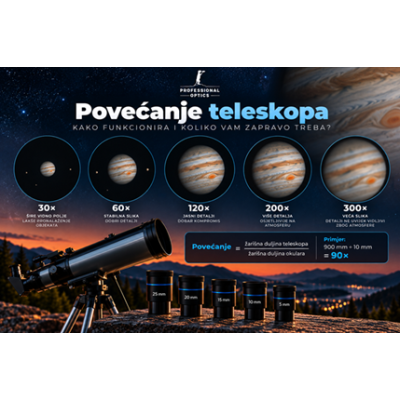
Telescope Magnification: How It Works and How Much You Really Need
When you start researching telescopes, one of the first specifications you will notice is magnification. 100×, 200×, 300× or even 500× may sound impressive. But does higher magnification automatically mean a better view of space?
Not necessarily.
Telescope magnification should be considered together with aperture, optical quality, the eyepiece and observing conditions. In many situations, lower magnification provides a clearer, more stable and more useful image.
What Does Telescope Magnification Mean?
Magnification determines how much larger an object appears through a telescope compared with viewing it with the naked eye.
For example, at 50× magnification, an object appears approximately 50 times larger than it does without a telescope.
Magnification is calculated using a simple formula:
Magnification = telescope focal length ÷ eyepiece focal length
Example for a telescope with a focal length of 900 mm:
900 mm ÷ 20 mm = 45×
900 mm ÷ 10 mm = 90×
900 mm ÷ 5 mm = 180×
Therefore, a telescope does not have one fixed magnification. By changing the eyepiece, you can change the magnification.
Why Does Higher Magnification Not Always Mean a Better Image?
At first glance, it may seem that the highest possible magnification is always the best choice. In reality, higher magnification also increases every weakness in the image.
The image may become:
less stable
narrower in field of view
more sensitive to vibrations
more affected by atmospheric turbulence
less sharp if the optics or conditions do not support higher magnification.
This means that a telescope producing a clear and stable image at 60× may show a larger but blurrier image at 150×.
Higher magnification only makes sense if the telescope, the atmosphere and the object you are observing can benefit from the additional magnification.
How Much Magnification Can a Telescope Actually Use?
A commonly quoted rough guideline is around 2× magnification per millimetre of aperture, but this is not a strict rule.
Useful magnification depends on:
aperture
optical quality
eyepiece quality
atmospheric conditions
mount stability
the object being observed.
As a rough reference:
Aperture | Approximate Maximum Magnification |
70 mm | Around 140× |
90 mm | Around 180× |
100 mm | Around 200× |
130 mm | Around 260× |
This does not mean that a telescope will provide a high-quality image at these values every time. Under real observing conditions, you will often use considerably lower magnification.
What Happens When You Increase Magnification?
Changing magnification changes several important image characteristics.
Lower Magnification
At lower magnification, you will usually get:
a wider field of view
a brighter image of extended objects
easier object finding
a more stable image
a better overview of large objects.
This is especially useful for large star clusters, large nebulae and some galaxies.
Higher Magnification
At higher magnification:
the object appears larger
the field of view becomes narrower
you may see more detail if conditions allow it
the image becomes more sensitive to atmospheric turbulence and vibrations.
This is why higher magnification is usually used for objects where you want to examine finer details.
Which Magnification Should You Use for the Moon?
The Moon is one of the best objects for experimenting with different magnifications.
At lower magnification, you can see the entire Moon and its position within a wider section of the sky. At higher magnification, you can observe craters, mountain ranges and other surface structures in greater detail.
However, you do not automatically need to use the highest possible magnification.
If you can see the Moon clearly and steadily at 60×, but the view becomes large, blurry and unsteady at 150×, then 60× is the better magnification at that moment.
What About Planets?
Planets are small objects in the sky, so they often benefit from higher magnification than large nebulae or star clusters.
Jupiter, Saturn and Mars can be very interesting at medium and high magnifications, but the truly useful magnification depends on the telescope and atmospheric conditions.
In good conditions, higher magnification may reveal more planetary detail. In poor conditions, it will only magnify a blurry image.
Why Are Galaxies and Nebulae Often Observed at Lower Magnification?
Galaxies, nebulae and large star clusters often cover a relatively large area of the sky.
For these objects, it is important to have a sufficiently wide field of view and good image surface brightness.
This is why galaxies, nebulae and large star clusters are often observed at low or medium magnification.
Higher magnification can be useful for certain smaller details, but it is not always the best starting point.
What Is the Telescope Exit Pupil?
The exit pupil is the diameter of the beam of light that leaves the eyepiece and enters your eye.
It can be calculated using a simple formula:
Exit pupil = aperture ÷ magnification
Example for a telescope with 100 mm optics:
At 50× → 100 ÷ 50 = 2 mm
At 100× → 100 ÷ 100 = 1 mm
At 200× → 100 ÷ 200 = 0.5 mm
The higher the magnification, the smaller the exit pupil. With extended objects such as nebulae and galaxies, this reduces the apparent surface brightness of the image.
This is why very high magnifications are not always suitable for observing faint and large deep-sky objects.
Which Eyepiece Produces Higher Magnification?
The rule is simple:
The shorter the eyepiece focal length, the higher the magnification.
For example, a telescope with a 900 mm focal length provides:
Eyepiece | Magnification |
25 mm | 36× |
20 mm | 45× |
15 mm | 60× |
10 mm | 90× |
5 mm | 180× |
This is why a 5 mm eyepiece provides much higher magnification than a 25 mm eyepiece.
However, this does not mean that a 5 mm eyepiece is “better.” Each eyepiece serves a different purpose.
Why Not Always Use the Highest-Power Eyepiece?
Imagine you have a telescope with a 900 mm focal length and a 5 mm eyepiece.
You get:
900 mm ÷ 5 mm = 180×
This can be very useful for the Moon or a planet in good conditions.
However, if the atmosphere is turbulent, the image may become blurry. If you are observing a large nebula, the narrow field of view can also make observation more difficult.
This is why it is more practical to have several eyepieces with different focal lengths and choose the magnification according to the object and observing conditions.
The Atmosphere Also Determines How Much Magnification You Can Use
Even a very high-quality telescope cannot completely eliminate the effects of Earth’s atmosphere.
Air turbulence can cause stars to “twinkle” and make planetary details less sharp.
At higher magnification, these problems become even more noticeable.
This is why the same telescope may provide an excellent image at 180× on one night, while on another night the image may become unsteady even at 100×.
Atmospheric quality is one of the main reasons why maximum magnification is not always useful magnification.
What Is a Barlow Lens?
A Barlow lens allows you to increase magnification without changing the telescope itself.
The most common type is a 2× Barlow lens, which doubles the magnification.
Example:
A 900 mm telescope with a 20 mm eyepiece:
900 mm ÷ 20 mm = 45×
With a 2× Barlow lens:
45× × 2 = 90×
A Barlow lens can be a practical way to create additional magnification combinations without buying a large number of eyepieces.
Can a Telescope Have 500× Magnification?
Technically, you can combine a telescope and an eyepiece to calculate very high magnification.
However, the real question is not whether 500× can be calculated, but whether the image at 500× will be useful.
With many telescopes, such high magnification will not provide more real detail. Instead, the image may become large, dark, blurry and highly sensitive to atmospheric conditions.
This is why manufacturers often state a recommended or maximum useful magnification range rather than only the theoretical possibility of combining eyepieces.
The Same Telescope Can Be Used at Different Magnifications
This is one of the most important things to understand before buying a telescope.
One telescope can be suitable for different kinds of observation because its magnification changes when you use different eyepieces.
For example:
25 mm eyepiece → lower magnification → wider field of view
10 mm eyepiece → medium magnification → more detail
5 mm eyepiece → high magnification → detailed observing in good conditions
There is no single “ideal” magnification for every observing situation.
Which Magnification Should You Use for Different Objects?
Object | Often Useful Magnification |
Large star clusters | Low |
Large nebulae | Low |
Galaxies | Low to medium |
Moon | Medium to high |
Planets | Medium to high |
Double stars | Medium to high |
Small lunar details | High, if conditions allow |
These are practical guidelines only. The truly optimal magnification depends on the telescope, the object and observing conditions.
The Most Important Rule: Look for Detail, Not a Number
The purpose of a telescope is not to achieve the highest possible magnification.
The goal is to obtain the greatest amount of useful detail with a clear and stable image.
If you increase magnification from 100× to 200× and the image becomes only twice as large without revealing additional detail, you have not gained a real advantage.
When choosing a telescope, it is therefore important to consider the entire optical system, not just the magnification number shown on the box.
Conclusion
Magnification is one of the most important telescope parameters, but it is not the only one.
High magnification does not automatically mean more detail.
For high-quality observation, you need to balance:
aperture
telescope focal length
eyepiece
magnification
optical quality
mount stability
atmospheric conditions
the object you are observing.
A well-chosen magnification is the one that provides a clear, stable and detailed image—not the one with the largest number on paper.
Frequently Asked Questions
How Much Magnification Does a Telescope Need for Observing Planets?
Medium and high magnifications are often used for observing planets, but there is no single ideal value. It depends on the aperture and quality of the optics, atmospheric conditions and the planet itself.
A clear and stable image is more important than using the highest possible magnification.
How Much Magnification Is Needed to Observe the Moon?
The Moon can be observed very well at different magnifications. Lower magnification allows you to see the entire Moon, while higher magnification allows closer observation of craters and finer surface details.
What Is the Best Magnification for a Beginner?
For beginners, it is practical to start with low or medium magnification. The image is usually more stable, the field of view is wider and objects are easier to find.
Later, you can increase magnification according to the object and observing conditions.
Why Does a Telescope Produce a Blurry Image at High Magnification?
High magnification also increases the effect of atmospheric turbulence, vibrations and optical limitations.
If magnification is too high for the current conditions, the object will look larger but not more detailed.
How Do I Know Whether Magnification Is Too High?
If increasing magnification does not reveal new detail and instead makes the image blurry, unsteady or very dark, you have probably exceeded the useful magnification for that moment.
Can I Use Different Eyepieces on the Same Telescope?
Yes. Changing the eyepiece changes magnification.
An eyepiece with a longer focal length provides lower magnification and a wider field of view, while a shorter focal length gives higher magnification.
Should I Buy a 5 mm Eyepiece for High Zoom?
Not necessarily. A 5 mm eyepiece can provide very high magnification, but it will not always be useful.
Before buying one, consider the aperture, telescope focal length and observing conditions.
Is a Barlow Lens Worth Using?
A Barlow lens can be practical because it increases existing magnification and allows more combinations with the same eyepieces.
For example, a 2× Barlow doubles the magnification.
Can Higher Magnification Show More Detail?
It can, but only if the telescope optics and observing conditions allow it.
If magnification is too high, increasing it further will not reveal more detail—it will only enlarge a blurry image.