
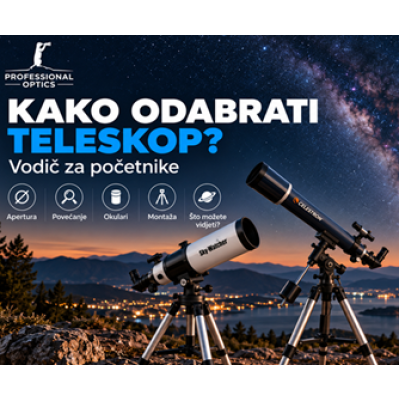
How to Choose a Telescope? A Beginner's Guide
Choosing your first telescope can seem complicated because specifications include numbers such as 70/700, 80/400 or 130/1000, different optical designs, eyepieces and mounts.
However, to get started, it is enough to understand a few key points: aperture, focal length, magnification, telescope type and mount.
If you know what you want to observe, where you will use the telescope and how important portability is to you, choosing becomes much easier.
If you are just starting out in astronomy, it is useful to first understand the basic telescope characteristics. In our detailed guides, you can separately learn about [What Is Telescope Aperture and Why Is It Important?], How Much Telescope Magnification Do You Really Need?, [Which Eyepiece Should You Choose for a Telescope?] and [Which Telescope Mount Should You Choose?].
 What Do the Numbers on a Telescope Mean?
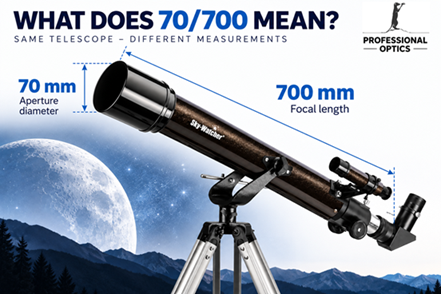
A designation such as 70/700 describes two basic optical parameters of a telescope:
- 70 mm – the diameter of the objective lens or mirror, i.e. the telescope aperture
- 700 mm – the focal length of the telescope
For example, a 70/900 telescope has an objective lens with a diameter of 70 mm and a focal length of 900 mm.
These two numbers provide important information about how much light the telescope can gather, what magnification it can achieve with a particular eyepiece and what field of view it can provide.
Examples of Telescopes in Our Range
Model | Type | Aperture | Focal Length | F-ratio |
Refractor | 70 mm | 900 mm | f/12.9 | |
Refractor | 70 mm | 700 mm | f/10 | |
Refractor | 70 mm | 800 mm | f/11.4 | |
Refractor | 80 mm | 400 mm | f/5 | |
Refractor | 90 mm | 900 mm | f/10 | |
Reflector | 114 mm | 500 mm | f/4.4 | |
Reflector | 130 mm | 1000 mm | f/7.7 |
This table already shows that telescopes with similar dimensions can have very different characteristics.
 What Is Telescope Aperture?
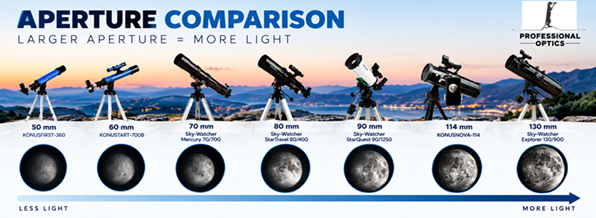
Aperture is the diameter of the telescope’s main optical element: the objective lens in a refractor or the primary mirror in a reflector.
A larger aperture allows a telescope to gather more light and, under ideal conditions, achieve better theoretical resolution. This is especially important when observing faint deep-sky objects such as galaxies and nebulae.
However, a larger aperture does not automatically make a telescope more practical. A larger telescope usually also means greater weight, larger dimensions and a more demanding mount.
This is why a telescope should not be chosen solely according to the largest possible aperture, but according to what you want to observe and how you plan to use it.
If you would like to understand in more detail how aperture affects brightness, resolution and telescope capabilities, read [What Is Telescope Aperture and Why Is It Important?].
What Is Telescope Focal Length?
Focal length is the distance between the main optical element and the point where the light is brought into focus.
Focal length affects magnification and field of view.
With the same eyepiece, a telescope with a longer focal length produces higher magnification.
Example:
- 70/700 telescope + 10 mm eyepiece = 70×
- 70/900 telescope + 10 mm eyepiece = 90×
This is why two telescopes with the same aperture can have a different observing character.
A shorter focal length generally provides a wider field of view and is often practical for larger objects and wide areas of the sky.
A longer focal length makes it easier to achieve higher magnification and can be particularly interesting for observing the Moon and planets.
 How to Calculate Telescope Magnification?
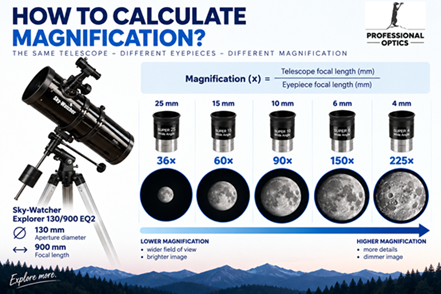
Magnification is not determined by the telescope alone. It depends on the combination of telescope and eyepiece.
The formula is:
Magnification=Telescope focal length:Eyepiece focal length
Example for a telescope with a focal length of 900 mm:
- 900 ÷ 25 = 36×
- 900 ÷ 20 = 45×
- 900 ÷ 10 = 90×
This is why a telescope does not have one fixed magnification.
If a telescope has several eyepieces, you can change the magnification simply by changing the eyepiece.
Example: Celestron AstroMaster 70EQ
The Celestron AstroMaster 70EQ has a focal length of 900 mm. With the included 20 mm eyepiece, it provides 45× magnification, while a 10 mm eyepiece provides 90× magnification.
This is a good example of a common beginner misunderstanding:
The number written on the telescope is not its magnification.
If you would like to understand in more detail how much telescope magnification is genuinely useful in practice, read [How Much Telescope Magnification Do You Really Need?].
Is Higher Magnification Always Better?
No.
Higher magnification makes an object appear larger, but it also reduces the field of view and increases the effect of atmospheric turbulence, mount vibrations and optical limitations.
If the magnification becomes too high for the particular conditions, the image may look larger but not more detailed.
This is why it is more important to have usable magnification and a stable image than simply to look for the highest magnification figure.
What Is a Telescope F-ratio?
The f-ratio, or focal ratio, is calculated by dividing the focal length by the aperture.
F-ratio=Focal lengthAperture\text{F-ratio} = \frac{\text{Focal length}}{\text{Aperture}}F-ratio=ApertureFocal length
Examples:
- 70/700 → f/10
- 70/900 → f/12.9
- 80/400 → f/5
- 90/900 → f/10
- 130/900 → f/6.9
- 130/1000 → f/7.7
A shorter f-ratio usually means a wider field of view and a more compact optical tube. A longer f-ratio usually gives a narrower view of the sky and can be practical for observing the Moon and planets.
The f-ratio is useful information, but you should not choose a telescope based on this specification alone.
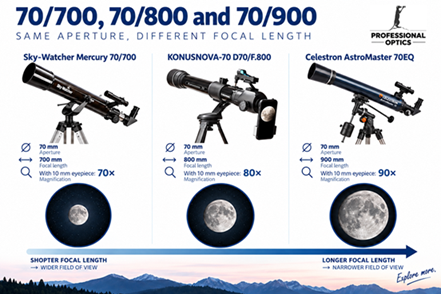 Why Are 70/700, 70/800 and 70/900 Not the Same Telescope?
At first glance, all three have the same objective diameter: 70 mm. However, their focal lengths are not the same.
This means they differ in magnification with the same eyepiece, field of view, optical tube length and overall observing character.
For example:
- Sky-Watcher Mercury 70/700 AZ2 has a focal length of 700 mm.
- KONUSNOVA-70 has a focal length of 800 mm.
- Celestron AstroMaster 70EQ has a focal length of 900 mm.
If we use a 10 mm eyepiece with all three telescopes, we get:
- 70/700 → 70×
- 70/800 → 80×
- 70/900 → 90×
Therefore, even when aperture is the same, focal length changes the way a telescope performs.
Four Telescopes, Four Different Approaches
For a beginner, it is often easier to understand the differences through practical examples than through technical definitions alone.
Celestron AstroMaster 70EQ – 70/900
This refractor combines a 70 mm objective lens with a 900 mm focal length. It comes with an equatorial mount.
Its longer focal length makes it relatively easy to achieve higher magnification with conventional eyepieces.
Sky-Watcher Mercury 70/700 AZ2 – 70/700
This model also has a 70 mm aperture, but its focal length is shorter at 700 mm.
Compared with a 70/900 telescope, it produces slightly lower magnification with the same eyepiece and offers a wider field of view. Its alt-azimuth mount is straightforward for basic manual pointing.
Sky-Watcher StarTravel 80/400 AZ3 – 80/400
This refractor has an 80 mm aperture and a focal length of only 400 mm.
That makes it very different from a 70/900 telescope: its optical tube is short, and the telescope is interesting for wide-field observation and portability.
KONUSNOVA-114 – 114/500
Here we move to a completely different optical system.
The KONUSNOVA-114 is a reflector with a 114 mm mirror and a focal length of 500 mm.
Its larger aperture compared with 70 mm refractors allows it to gather more light, while its relatively short focal length gives it a different observing character.
.jpg) Which Telescope Types Are Available?
The main telescope types you will most often encounter are refractors, reflectors and catadioptric telescopes.
Refractor
A refractor uses a lens as its main optical element.
Advantages:
- Simple optical system
- Usually does not require collimation
- Easy to use
- Suitable for beginners
Some refractors may show chromatic aberration, meaning coloured fringes around very bright objects.
Reflector
A reflector uses mirrors to collect and focus light.
Advantages:
- Can provide a relatively large aperture
- Often offers a lot of optical performance for its size
- Very interesting for observing deep-sky objects
With reflectors, you need to learn how to check and, when necessary, adjust the collimation of the optical system.
Catadioptric Telescope
A catadioptric telescope combines mirrors and lenses.
This design allows for a compact optical tube with a relatively long focal length.
If you would like a more detailed comparison of the two most common optical systems, see Refractor or Reflector – Which Telescope Should You Choose?.
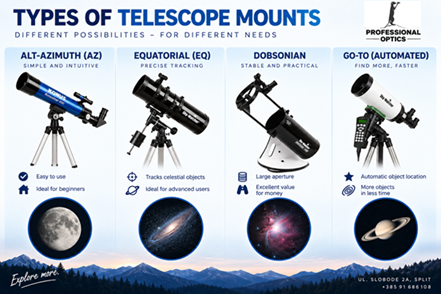 Which Telescope Mount Should You Choose?
The mount is just as important for practical telescope use as the optical tube itself.
You will most commonly encounter three main approaches.
Alt-Azimuth Mount (AZ)
The telescope moves:
- Left and right
- Up and down
This is a simple way to operate a telescope and is very suitable for visual observing.
Equatorial Mount (EQ)
An equatorial mount uses an axis aligned with the celestial pole.
After proper setup, it allows easier tracking of objects as the Earth rotates.
An example of this approach in our range is the Celestron AstroMaster 70EQ.
Dobsonian Mount
A Dobsonian mount is a simple and highly stable mount most commonly used with Newtonian telescopes. The telescope is moved manually in altitude and azimuth.
Advantages: excellent stability, ease of use and the ability to support telescopes with large apertures. It is particularly well suited to visual observation of the Moon, planets and deep-sky objects.
GoTo System
GoTo is an electronic system for automatically pointing the telescope at a selected object and tracking it.
It is important to understand that GoTo is not a type of optical design. A telescope with a GoTo system can be a refractor, reflector or catadioptric telescope.
Alt-azimuth, equatorial and GoTo mounts all offer different advantages and operating methods. You can find a detailed comparison in the guide [Which Telescope Mount Should You Choose?].
What Can You See Through a Telescope?
This depends on aperture, optical quality, magnification, atmospheric conditions, light pollution and the object itself.
The Moon
The Moon is one of the easiest and most rewarding objects to observe. Even a relatively small aperture makes it possible to see many details on its surface.
Planets
Jupiter, Saturn, Mars and Venus can be observed through a telescope, but their appearance depends on observing conditions.
For planets, it is especially important to have a stable mount and to use magnification appropriate for the current atmospheric conditions.
If you are primarily interested in planets, see [Which Telescope Is Best for Observing Planets?].
Galaxies and Nebulae
Deep-sky objects require the darkest possible sky and sufficient aperture.
It is important to have realistic expectations: what you see through a telescope with your own eyes does not look the same as photographs of galaxies and nebulae taken with long exposures and processed on a computer.
Astrophotography and visual observing are two different things.
For a detailed guide to choosing a telescope for deep-sky objects, see [LINK → Which Telescope for Galaxies and Nebulae?].
Where Will You Use the Telescope?
This is a question that is often overlooked.
If you use a telescope from a city, light pollution makes it more difficult to observe faint deep-sky objects.
For the Moon and planets, city skies are much less of a problem.
If you can take the telescope to a darker location outside the city, the possibilities for observing faint objects increase significantly.
Before purchasing, consider this:
Will the telescope mostly be used from a balcony, in a garden, or will you often take it outside the city?
A telescope that you will actually take with you is often more practical than a larger model that stays at home because of its size.
Which Telescope Should You Choose for the Moon and Planets?
For the Moon and planets, telescopes that allow higher magnification and have a stable mount are especially interesting.
Refractors with longer focal lengths, such as the Celestron AstroMaster 70EQ 70/900 or Sky-Watcher Evostar 90/900 AZ3, are examples of telescopes with relatively long focal lengths.
When choosing, it is not enough to look only at the maximum advertised magnification. Aperture, optical quality, mount stability and observing conditions are more important.
Which Telescope Should You Choose for Galaxies and Nebulae?
For faint deep-sky objects, aperture is important because a larger optical element can collect more light.
This is why reflectors with larger apertures can be very interesting for this purpose.
For example, the KONUSNOVA-114 has a 114 mm aperture, while the KONUSMOTOR-130 has a 130 mm aperture.
However, aperture alone is not enough. Location is also important for deep-sky observing, as dark skies often make a major difference.
What If I Want a Small, Portable Telescope?
If portability is important to you, it is not always necessary to look for the largest telescope that fits your budget.
Short-focus models can have a shorter optical tube and be more practical for transport.
One example is the Sky-Watcher StarTravel 80/400 AZ3, which combines an 80 mm aperture with a 400 mm focal length.
For travel and quick observing sessions, this type of telescope can be more practical than a telescope with a long optical tube.
Do I Need More Eyepieces?
In most cases, it is useful to have at least two different magnifications.
One eyepiece with a longer focal length gives lower magnification and a wider field of view. Another one, with a shorter focal length, provides higher magnification.
Example for a telescope with a 900 mm focal length:
Eyepiece | Magnification |
25 mm | 36× |
20 mm | 45× |
10 mm | 90× |
5 mm | 180× |
However, a 5 mm eyepiece does not automatically mean you will always get a useful 180× image.
Practical magnification depends on the telescope and observing conditions.
An eyepiece is one of the most important telescope accessories because it determines the final magnification and affects the field of view. Learn more in the guide [Which Eyepiece Should You Choose for a Telescope?].
How to Choose a Telescope by Intended Use
What Matters Most | What to Consider |
Moon and planets | Aperture, focal length and mount stability |
Galaxies and nebulae | Larger aperture and dark skies |
Simple visual observing | A simple alt-azimuth mount |
Tracking objects | An equatorial or GoTo mount |
Frequent transport | A compact optical tube and lightweight mount |
Family use | Easy setup and straightforward operation |
Astrophotography | Carefully choose the mount and tracking system |
Common Mistakes When Buying a First Telescope
1. Looking Only at the Highest Magnification
A figure such as 300× or 400× sounds impressive, but it does not by itself indicate how good the image will be.
2. Confusing Magnification and Objective Diameter
70/900 does not mean 900× magnification.
It means:
- 70 mm aperture
- 900 mm focal length
3. Ignoring the Mount
Good optics on an unstable tripod can create a very frustrating experience.
4. Buying a Telescope That Is Too Large
If it is difficult to transport, set up or store, there is a good chance it will be used less often.
5. Expecting Colour Photographs Through the Eyepiece
The visual appearance of galaxies and nebulae is often much more subtle than the photographs you see online.
6. Choosing a Telescope Only by Price
Two telescopes at a similar price can be completely different in terms of optical design, aperture, mount and intended use.
Which Telescope Is Best for a Beginner?
There is no single telescope that is best for every beginner.
The right choice depends on:
- What you want to observe
- How much aperture you need
- How important portability is to you
- Whether you want a simple or more advanced mount
- Where you will use the telescope
For example, a beginner who wants simple visual observing will need a different telescope than someone whose main priority is a large aperture or who plans to move into astrophotography later.
It is therefore better to first define how you will use the telescope and only then choose a specific model.
Quick Telescope Selection Guide
Do you want a simple telescope to get started?
→ Look for a simple mount and easy operation.
Are you mainly interested in the Moon and planets?
→ Consider aperture, focal length and mount stability.
Are you interested in galaxies and nebulae?
→ Prioritise a larger aperture and a dark observing location.
Will you travel frequently with the telescope?
→ Portability may be more important than maximum aperture.
Do you want automatic object finding?
→ Consider a GoTo system.
Are you considering astrophotography?
→ The mount and tracking system become especially important.
Frequently Asked Questions
Is a 70/900 telescope better than a 70/700 telescope?
This cannot be answered based on those numbers alone. Both telescopes have a 70 mm aperture, but they have different focal lengths, which gives them different characteristics and makes them suitable for somewhat different uses.
Is a larger aperture always better?
A larger aperture allows the telescope to collect more light and offers greater theoretical resolution, but it also makes the telescope larger and heavier. For practical use, you should consider the complete system, not only the optical diameter.
Can I see galaxies with a telescope?
Yes. Many galaxies are available for visual observation, but their appearance depends on aperture, location, light pollution and observing conditions. Many will appear as very faint, diffuse objects rather than the photographs seen online.
Do I need a telescope with a GoTo system?
Not necessarily. GoTo is useful if you want electronic object finding and tracking, but a simple manual mount can be completely sufficient for visual observation.
Can I use a telescope from a city?
Yes. The Moon and planets can be observed very well from urban areas. Light pollution is a greater problem when observing faint deep-sky objects.
How Much Magnification Do I Need?
There is no single universal magnification. For a beginner, it is more useful to have several different magnification options than to use the highest possible magnification all the time.
Telescope Selection Guides
If you would like to explore individual aspects in more detail before purchasing, also see the other guides in our series:
- What Is Telescope Aperture and Why Is It Important?
- How Much Telescope Magnification Do You Really Need?
- Which Eyepiece Should You Choose for a Telescope?
- Refractor or Reflector – Which Telescope Should You Choose?
- Which Telescope Mount Should You Choose?
- Which Telescope Is Best for Observing Planets?
- Which Telescope for Galaxies and Nebulae?
- What Can You See Through a Telescope?
- How to Properly Set Up and Use a Telescope
- Telescope for Children – How to Choose a First Telescope
- Telescope for Astrophotography
Conclusion: How to Actually Choose a Telescope
When buying your first telescope, do not start with the question: “How much magnification does it have?”
Start with five simpler questions:
- What do I want to observe?
- How much aperture do I need?
- Which focal length suits my needs?
- What type of mount do I want?
- How important is portability to me?
Once you answer these questions, choosing a telescope becomes much easier.
If you are still unsure which model would suit your needs, comparing specific telescopes such as 70/700, 70/900, 80/400, 90/900 or 130/1000 can help turn technical specifications into a practical understanding of how a telescope will perform in real-world use.