
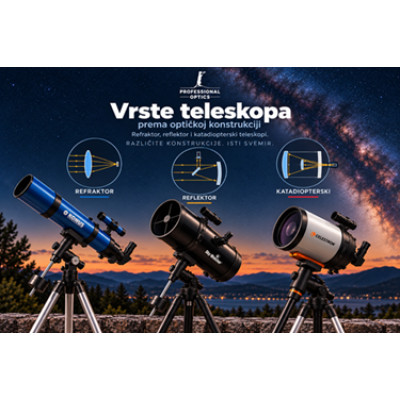
Telescope Types by Optical Design: Refractors, Reflectors and Catadioptric Telescopes
Why Do Different Telescope Optical Designs Exist?
At first glance, telescopes may look very similar, but their internal optical systems can be completely different.
Some telescopes use lenses, others use mirrors, and some designs combine both lenses and mirrors. The difference is not only in the telescope’s appearance. Its optical design determines how light enters the telescope, how it is directed towards the focal point and what characteristics the optical tube itself has.
This is why telescope names often include terms such as refractor, reflector, Newtonian, Cassegrain, Maksutov or Schmidt-Cassegrain. For a beginner, these may seem like a collection of unrelated names, although there is actually a fairly clear structure.
Everything can be simplified into three main groups:
- Refracting telescopes – use lenses
- Reflecting telescopes – use mirrors
- Catadioptric telescopes – combine lenses and mirrors
Within these groups, there are several different optical designs.
Simplified Structure
Refractors
→ Achromatic refractors
→ Apochromatic refractors
Reflectors
→ Newtonian
→ Cassegrain
→ Other reflecting designs
Catadioptric telescopes
→ Maksutov-Cassegrain
→ Schmidt-Cassegrain
→ Maksutov-Newton
→ Schmidt-Newton
This classification matters because, for example, a Newtonian telescope is not a separate category alongside reflectors. A Newtonian is one type of reflector.
In other words:
Every Newtonian is a reflector, but not every reflector is a Newtonian.
 1. Refracting Telescopes: Optics That Use Lenses
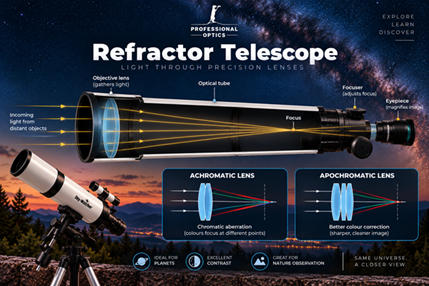
A refractor is the easiest telescope type to recognise: at the front end of the optical tube, there is an objective lens, or a system of lenses.
Light from the observed object enters through the objective lens, passes through the lenses and is refracted so that an image forms at the other end of the optical tube. The eyepiece then allows you to observe that image.
In its simplest form, the optical path looks like this:
Object → objective lens → focus → eyepiece → eye
Unlike a reflector, a refractor does not have a primary mirror that reflects light towards the rear of the telescope or a secondary mirror in the middle of the optical tube.
This is why refractors have a very simple and enclosed optical design.
How Does a Refractor Perform in Practice?
Refractors are known for delivering a high-contrast, clean image. They are especially interesting for observing the Moon, planets, double stars and other bright objects.
Models with shorter focal lengths can also provide a wider field of view, making them suitable for observing larger areas of the sky.
Another important characteristic is that a refractor does not require collimation of the main optics in the same way as conventional reflectors. This makes it very easy to use.
However, lens-based optics have one well-known characteristic: chromatic aberration.
Achromatic Refractor
The most common conventional refractors use an objective lens consisting of two different lens elements to reduce colour separation caused by light passing through glass.
This type of system is called an achromatic refractor.
With very bright objects, especially at higher magnifications, some achromatic refractors may show a purple or bluish fringe around the edges of the object. This is the result of chromatic aberration.
This does not mean the telescope is defective. It is a characteristic of a particular type of optical design.
In refractors with longer focal lengths, this effect is often less noticeable.
At Professional Optics, for example, our conventional refractors include the Sky-Watcher Mercury 70/700, StarTravel 80/400 and Evostar 90/900. All three use lens-based optics, but they have different dimensions and focal lengths, so their observing characteristics also differ.
What Is an Apochromatic Refractor?
An apochromatic refractor, or apochromat, uses a more advanced optical design that provides significantly better correction of chromatic aberration.
This is achieved through the careful combination of different types of optical glass and, depending on the design, a greater number of objective lens elements.
The result is a very well-corrected image with much less unwanted colour fringing.
This is why apochromatic refractors are especially interesting for observers who want very high-quality optics, as well as for astrophotographers.
It is important to remember:
Achromatic and apochromatic telescopes are not two completely different telescope types. Both are refractors. The difference lies in the construction and degree of correction of the objective lens.
 2. Reflecting Telescopes: When a Mirror Replaces the Lens
With reflectors, the principle changes completely.
Instead of using an objective lens to refract light, the telescope uses a mirror that reflects light.
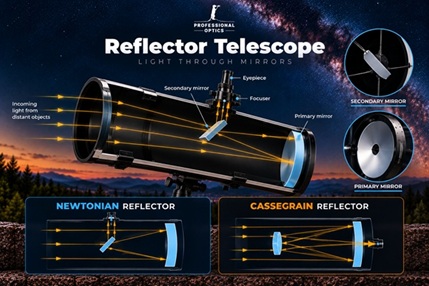
The primary mirror is located at the bottom of the optical tube. Light entering through the telescope aperture travels towards it, is reflected and is then directed towards the focal point through the particular optical design.
This is why reflecting telescopes can look completely different from refractors.
In a conventional reflector, there is usually also a secondary mirror inside the optical tube. Its purpose is to redirect the light towards the eyepiece position.
This brings us to one of the best-known reflector designs: the Newtonian.
Newtonian: The Best-Known Reflector Design
The Newtonian telescope is named after Isaac Newton and is one of the most widespread reflector optical designs.
In a Newtonian telescope, a concave primary mirror is located at the bottom of the telescope. It collects and focuses light towards the front part of the optical tube.
Before the light returns towards the primary mirror, a small flat secondary mirror positioned at approximately 45° redirects the light towards the side of the tube.
This is why the eyepiece of a Newtonian telescope is not located at the rear of the telescope, but on the side, near the front end of the optical tube.
Simplified optical path:
Light → primary mirror → secondary mirror → eyepiece
This is an elegant solution. The telescope can have relatively large optics while keeping the design comparatively simple.
Why Are Newtonian Telescopes So Popular?
One reason is that relatively large reflecting optics can be produced without a large number of complex lens elements.
In a Newtonian telescope, the primary mirror is the most important optical component, while the secondary mirror simply redirects the already focused light towards the eyepiece.
The Newtonian design can therefore be very interesting for observing a wide range of objects, from the Moon and planets to many deep-sky objects.
However, there is one thing a Newtonian owner needs to learn: collimation.
What Is Newtonian Telescope Collimation?
The mirrors in a reflector must be properly aligned so that the light ends up exactly where it should.
During transport, use or simply because of small mechanical shifts, the optics can move slightly.
When that happens, the position of the mirrors needs to be adjusted. This procedure is called collimation.
With some telescopes, collimation is easy and rarely necessary, while with others, the user will eventually need to learn how to perform it correctly.
This is one of the fundamental differences between a conventional refractor and a Newtonian reflector.
Cassegrain: A Reflector That “Folds” the Optical Path
Cassegrain is another important reflector design.
At first glance, it may look somewhat unusual because the optical tube is relatively short compared with the focal length it can achieve.
How?
Because the light does not travel through the telescope only once.
In a Cassegrain telescope, light enters through the telescope aperture and reaches the primary mirror. The mirror reflects the light towards the secondary mirror, which sends it back towards the rear of the telescope, where the focus is located.
In other words, the optical path is “folded” inside the tube.
This is the central idea of the Cassegrain design.
It is also important to make a distinction here:
A classical Cassegrain is a reflecting telescope.
Only when corrective optical elements are added to this principle do we get catadioptric designs such as Maksutov-Cassegrain and Schmidt-Cassegrain telescopes.
 3. Catadioptric Telescopes: A Combination of Lenses and Mirrors
The term catadioptric telescope may sound the most complicated, but the basic idea is actually simple:
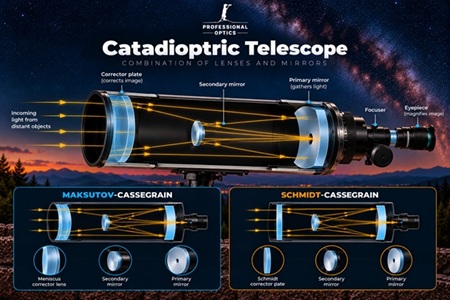
A catadioptric telescope combines lenses and mirrors.
Unlike a pure refractor, which uses lenses, or a reflector, which uses mirrors, a catadioptric system uses both types of optical elements.
Why?
By combining different elements, designers can take advantage of their strengths while also correcting certain optical imperfections.
Most popular catadioptric telescopes use a folded optical path principle. Light travels through the optical system several times, allowing a long focal length to fit into a relatively short tube.
This group includes, among others:
- Maksutov-Cassegrain
- Schmidt-Cassegrain
- Maksutov-Newton
- Schmidt-Newton
Now we come to two very well-known designs.
Maksutov-Cassegrain: A Combination of a Corrector Lens and Mirrors
A Maksutov-Cassegrain telescope is often simply called a Maksutov.
Essentially, it is a Cassegrain reflector design with a Maksutov corrector element added to the front of the telescope.
This is why a Maksutov-Cassegrain belongs to the catadioptric telescope category: it uses both a lens-like corrective element and mirrors.
Light first passes through the corrector lens at the front of the telescope. It then reaches the primary mirror, returns towards the front and is redirected by a secondary reflective element towards the focal point at the rear of the telescope.
Simplified optical path:
Light → corrector lens → primary mirror → secondary element → focus → eyepiece
This combination of elements makes it possible to create a compact telescope with a relatively long focal length.
For this reason, Maksutov-Cassegrain telescopes often have a characteristically short and relatively thick optical tube.
How Does a Maksutov Perform in Practice?
Its long focal length is especially suitable for observing objects for which higher magnification is useful, such as the Moon, planets and double stars.
On the other hand, this type of design is not usually intended as a telescope for an extremely wide field of view.
At Professional Optics, for example, we offer the Sky-Watcher Maksutov StarQuest 90/1250. The name itself reveals the basic information: it is a Maksutov design, with a 90 mm optical diameter and a focal length of 1250 mm.
Another example is the Sky-Watcher SkyMax-127 AZ-GTi GoTo WiFi, which uses Maksutov-Cassegrain optics.
Schmidt-Cassegrain: A Similar Principle, Different Corrective Optics
A Schmidt-Cassegrain telescope also combines the Cassegrain reflecting arrangement with a corrective optical element.
The main difference compared with a Maksutov-Cassegrain lies precisely in this front corrective element.
A Schmidt-Cassegrain uses a Schmidt corrector plate, while a Maksutov uses a different corrective element with a characteristic meniscus shape.
Both designs have the same basic goal: to combine the benefits of reflecting optics with a corrective element while creating a compact telescope with a relatively long focal length.
This is why they may look similar at first glance, even though their internal optics are not the same.
Maksutov-Newton and Schmidt-Newton
There are also designs that combine corrective optics with the Newtonian optical arrangement.
Maksutov-Newton
A Maksutov-Newton combines:
- A Maksutov corrector element
- A Newtonian reflector optical configuration
In other words, it still has a primary mirror and secondary mirror as in a Newtonian telescope, but a corrective element is added at the front.
Schmidt-Newton
A Schmidt-Newton similarly combines:
- A Schmidt corrector plate
- A Newtonian reflector design
These designs are not as common among entry-level telescopes as conventional Newtonians, Maksutov-Cassegrains or Schmidt-Cassegrains, but they are important because they show how many different ways there are to combine lenses and mirrors.
How Are All These Designs Connected?
If we simplify everything, we get a very logical “family” of telescopes:
Optical Design | Main Group | What Does It Use? |
Achromatic refractor | Refractor | Lenses |
Apochromatic refractor | Refractor | Lenses |
Newtonian | Reflector | Mirrors |
Cassegrain | Reflector | Mirrors |
Maksutov-Cassegrain | Catadioptric | Lenses + mirrors |
Schmidt-Cassegrain | Catadioptric | Lenses + mirrors |
Maksutov-Newton | Catadioptric | Lenses + mirrors |
Schmidt-Newton | Catadioptric | Lenses + mirrors |
The most important thing to remember is this basic logic:
REFRACTOR → lenses
REFLECTOR → mirrors
CATADIOPTRIC → lenses + mirrors
Within each group, there are different optical designs.
Where Do Dobsonian and GoTo Fit In?
This is where beginners often become confused again, because telescope names may also include terms such as Dobsonian, AZ, EQ or GoTo.
However, these are not the same thing.
Newtonian, Maksutov-Cassegrain and refractor describe the optical design.
Dobsonian, alt-azimuth and equatorial mounts describe the way the telescope is mounted and moved.
GoTo describes an electronic system that helps automatically find and track objects in the sky.
This is why one telescope can simultaneously be, for example:
- A Maksutov-Cassegrain with an alt-azimuth GoTo mount
- A Newtonian reflector on a Dobsonian mount
These are not competing optical designs. They are different parts of the complete telescope system.
Different telescope mount types can be covered in more detail in a separate guide.
How to Identify a Telescope Design From Its Name
Once you understand this classification, telescope names become much clearer.
Sky-Watcher Mercury 70/700
- Refractor
- 70 mm → objective lens diameter
- 700 mm → focal length
Sky-Watcher StarTravel 80/400
- Refractor
- 80 mm → objective lens diameter
- 400 mm → focal length
Sky-Watcher Explorer 130/900
- Newtonian reflector
- 130 mm → primary mirror diameter
- 900 mm → focal length
Sky-Watcher Maksutov StarQuest 90/1250
- Maksutov-Cassegrain
- 90 mm → optical diameter
- 1250 mm → focal length
Sky-Watcher SkyMax-127 AZ-GTi GoTo WiFi
- Maksutov-Cassegrain with a GoTo mount
Therefore, a telescope name can simultaneously contain information about the optical design, optical dimensions and type of mount.
What Is Most Important to Remember?
You do not need to memorise every name and detail of each optical layout. It is enough to first understand the basic structure:
- A refractor uses lenses.
- A reflector uses mirrors.
- A Newtonian is one type of reflector.
- A Cassegrain is also a reflector optical design.
- Maksutov-Cassegrain and Schmidt-Cassegrain telescopes combine mirrors with corrective optics, so they belong to the catadioptric telescope category.
Only after that does it make sense to examine details such as optical diameter, focal length, focal ratio, eyepieces and mounts.
This way, the different names no longer look like a random combination of astronomical terms, but rather like parts of one logical optical structure.
Frequently Asked Questions About Telescope Optical Designs
Is a Refractor Better Than a Reflector?
There is no one optical design that is better for every purpose. A refractor uses lenses, while a reflector uses mirrors, so they differ in their optical construction, maintenance requirements and overall design.
It is more important to understand the differences between the designs and their characteristics than to search for one universally “better” telescope.
Is a Newtonian the Same as a Reflector?
Not exactly.
A Newtonian is one type of reflecting telescope. Reflectors include several different optical designs, including Newtonian and Cassegrain telescopes.
The simplest explanation is:
- Reflector = a broad category of telescopes with mirrors
- Newtonian = one specific optical design within that category
Is Maksutov the Same as Maksutov-Cassegrain?
In everyday language, people often simply say Maksutov or Mak, especially in catalogues and among amateur astronomers.
However, the full name Maksutov-Cassegrain more precisely describes a particular optical design. There are also other Maksutov designs, such as the Maksutov-Newton.
Why Is a Maksutov Telescope So Short if It Has a 1250 mm Focal Length?
Because light does not travel through the tube only once.
A Maksutov-Cassegrain uses a folded optical path. Light passes through the front corrective element, reaches the primary mirror, returns towards the front and is then directed towards the focal point at the rear.
This allows the telescope to have a long focal length while remaining relatively compact.
Why Does a Newtonian Have Its Eyepiece on the Side?
Because of the position of the secondary mirror.
The primary mirror at the bottom of the telescope reflects light towards the front part of the optical tube. A small secondary mirror then redirects that light at a right angle towards the side-mounted focuser.
This is why the eyepiece in a Newtonian telescope is located on the side rather than at the rear.
Why Does a Reflector Have Two Mirrors?
In a Newtonian telescope, the secondary mirror is not there to provide additional magnification.
Its main purpose is to redirect the light collected and focused by the primary mirror towards the eyepiece position.
In other reflector designs, such as a Cassegrain, the secondary mirror has a different role in forming and directing the optical path.
Does Every Reflector Have a Secondary Mirror?
They should not all be described in the same way.
Many reflecting designs use a secondary mirror, but its shape, location and role depend on the particular optical configuration.
Therefore, it is better not to learn the rule “reflector = two mirrors,” but to understand that a reflector uses mirror-based optics, while different designs use different mirror arrangements.
Does a Newtonian Telescope Need Collimation?
Yes. With Newtonian reflectors, collimation is a normal part of maintaining the optics.
Collimation adjusts the alignment of the optical elements so that the light reaches the focal point correctly. How often it is needed depends on the telescope, how it is used and how frequently it is transported.
This is not a sign that anything is wrong with the telescope. It is simply part of reflector design.
Does a Refractor Need Collimation Like a Newtonian?
A conventional refractor does not use the same primary-mirror collimation procedure because it does not have the primary and secondary mirrors found in a Newtonian telescope.
This is one of the reasons why refractor design is optically simple to use.
Why Do Some Refractors Show a Purple Fringe Around the Moon or Stars?
This is usually chromatic aberration, which occurs because different wavelengths of light do not focus at exactly the same point.
In certain achromatic refractors, the effect can be visible around very bright objects, especially at higher magnifications.
Apochromatic designs use more complex optics to correct chromatic aberration much more effectively.
Is an Apochromat Simply a “Better Refractor”?
An apochromatic refractor is a more advanced type of refractor with better colour correction, but it is not only a matter of “better” or “worse.”
The term apochromatic describes how the objective lens is designed and corrected. As with other designs, different telescopes may be intended for different needs.
Why Does a Catadioptric Telescope Have Both a Lens and a Mirror?
Combining lenses and mirrors allows designers to create a very compact optical system while controlling certain optical imperfections.
Maksutov-Cassegrain and Schmidt-Cassegrain telescopes are good examples: the front corrective element works together with the mirrors inside the telescope.
Is a Schmidt-Cassegrain the Same as a Maksutov-Cassegrain?
No.
Both are catadioptric telescopes and both use the Cassegrain principle of folding the optical path, but they use different corrective optical elements.
A Schmidt-Cassegrain uses a Schmidt corrector plate, while a Maksutov-Cassegrain uses a Maksutov corrector element.
Is a Dobsonian a Type of Telescope?
Not in an optical sense.
Dobsonian describes a mount and the way the telescope is supported, rather than its optical design.
A Dobsonian telescope most commonly uses a Newtonian optical tube mounted on a simple Dobsonian mount.
This is why it is entirely correct to say “a Newtonian on a Dobsonian mount.”
Is GoTo a Separate Type of Telescope?
No.
GoTo is not an optical design. It is an electronic system that uses motors and control electronics to automatically find specific objects in the sky and track their movement.
A telescope with a GoTo system can be a refractor, Newtonian, Maksutov-Cassegrain or another optical design.
Why Can Two Telescopes of the Same Size Look Completely Different?
Because the number describing the optical diameter does not tell you how the optics are constructed.
For example, a telescope with a 90 mm aperture can be a refractor with a long tube, while a Maksutov-Cassegrain with a similar aperture can have a much shorter and thicker optical tube.
Both can have the same optical diameter but a completely different optical path.